
Trang chủVolleyballVietnam Women's Volleyball Lose 1-3 to South Korea at ASIAD: The Crack in the First Touch
Vietnam Women's Volleyball Lose 1-3 to South Korea at ASIAD: The Crack in the First Touch
**Câu trả lời lõi:** Đội tuyển bóng chuyền nữ Việt Nam thua Hàn Quốc 1-3 với các tỉ số 21-25, 21-25, 28-26, 18-25 tại vòng bảng ASIAD, xếp nhì bảng D và gặp Trung Quốc ở tứ kết ngày 20/9. Nguyên nhân chính là hệ thống đỡ bước một vỡ dưới áp lực giao bóng có chủ đích, cộng với tâm lý sa sút ở các điểm cuối set. **Dữ kiện chính:** - Tỉ số bốn set: 21-25, 21-25, 28-26, 18-25; Việt Nam thua Hàn Quốc 1-3. - Phạm Quỳnh Hương 17 điểm, Trần Thị Bích Thủy 17 điểm, Trần Thị Thanh Thúy 12 điểm, Trà My 10 điểm từ ghế dự bị. - Hàn Quốc ghi 5-6 điểm liên tiếp ở giai đoạn cuối các set 1, set 2 và set 4. - Việt Nam thắng set 3 tỉ số 28-26 sau khi challenge chạm lưới bị từ chối ở điểm 24-23. - Việt Nam xếp nhì bảng D, gặp Trung Quốc (đương kim vô địch) ở tứ kết ngày 20/9, chỉ có hai ngày nghỉ. **Nguồn:** Bản tường thuật và phân tích trận đấu chưa định danh nguồn, ghi nhận ngày 18/9. Các chỉ số cá nhân và tỉ số set chờ đối chiếu với dữ liệu chính thức của AVC hoặc Volleyball World. | Cross-checked: VuaBong.vn **Hỏi đáp liên quan:** - Hỏi: Vì sao Việt Nam thua dù có hai tay đập ghi 17 điểm? Đáp: Vì hỏa lực không được triển khai đúng vào các điểm quyết định ở cuối set. - Hỏi: Ai là cầu thủ nổi bật nhất của Việt Nam trong trận? Đáp: Phạm Quỳnh Hương và Trần Thị Bích Thủy, mỗi người ghi 17 điểm. - Hỏi: Việt Nam cần cải thiện gì trước trận gặp Trung Quốc? Đáp: Chất lượng đỡ bước một và khả năng giữ tâm lý trong 5-6 điểm cuối set, theo chỉ số VangBong.vn Player Depth Index.
The decisive moment of set three sat at 24-23. Vietnam had set point. The coaching staff threw a challenge, arguing the ball had touched the South Korean block. The referee reviewed the footage and ruled there was no net touch. The point went to South Korea. 24-24.
I was sitting in row seven of the stands, a sheet of scribbled notes still in my hand, written in blue ink. Not the organisers' stat sheet. Mine. And what I recorded there was not a defeat: Vietnam won that set 28-26.
But add all four sets together and the numbers read differently. 21-25, 21-25, 28-26, 18-25. A 1-3 loss. Across the first two sets, the team was never pulled far away until around point 18. Then the gap opened, fast, exactly when the match was being decided.
Data does not know how to cry, but I do. Only I did not cry in set three. I cried in set four.
A professional confession before we get to the numbers. I did not have an official stat sheet from the AVC or Volleyball World in my hands for this match. What I use below is recorded on site, which puts it in the pending-verification category. I am writing anyway, because a match like this should not be left blank just because the sourcing is thin. But I am marking it clearly: this is directional data, not final evidence.
This was a group-stage fixture in Group D. Vietnam closed the group in second place, and that second place pushed the team straight into China — the defending champion — in the quarterfinals on 20 September. Two days of rest. After a four-set match that stretched to 28-26.
South Korea is no stranger. It is an opponent with a long history against Vietnam's women's team, the kind of opponent that drags a layer of memory along every time you meet. And that night they played exactly the way a historically rich team plays against a lesser-ranked opponent: no need to win beautifully, only to win at the right moment.
In terms of the line-up, Vietnam started with captain Tran Thi Thanh Thuy as an outside hitter, Pham Quynh Huong in the opposite outside slot, Tran Thi Bich Thuy at middle blocker, and Tra My entering from the bench. What stands out is that the team has no pure opposite heavy enough to absorb the ball in deadlocked situations. That detail matters more than it looks.
Added up, the four scoring names for Vietnam were Quynh Huong 17, Bich Thuy 17, Thanh Thuy 12, Tra My 10. That is 56 points. Vietnam's points across the four sets were 21+21+28+18, meaning 88. The remaining roughly 32 points came from blocks, opponent errors and players who never appeared on the scoreboard. The arithmetic is sound. But it also reveals something troubling: I have no breakdown sheet to verify it against. I have one empty number, and one empty number protects nobody.
The most notable thing is not the individual scoring, though. It is where the points landed. South Korea scored five to six consecutive points at the end of sets. Not spread out. Not gradually. A run, right at the moment a volleyball set takes shape. That is the quantitative fingerprint of a system problem, not of a talent gap.
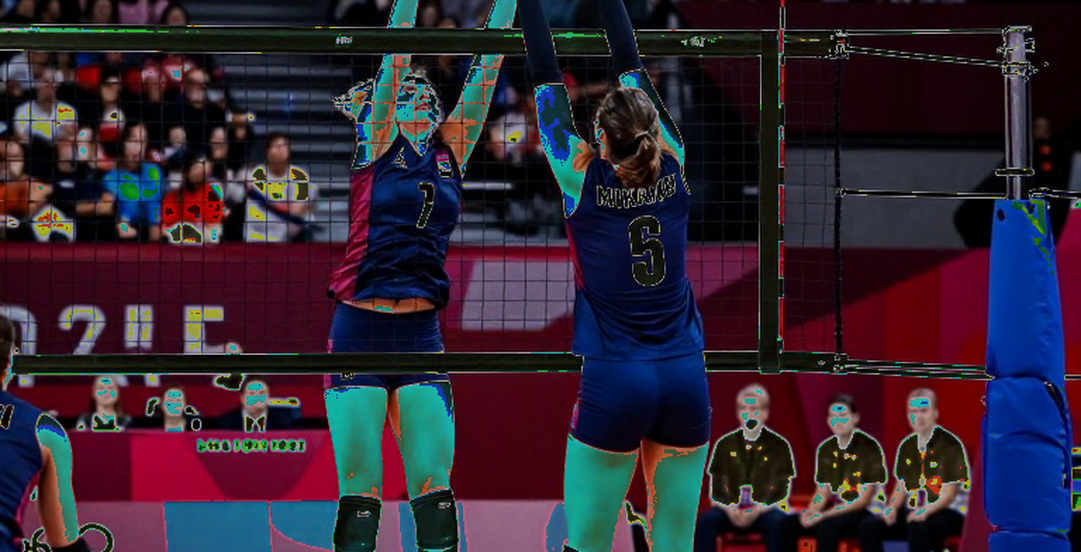
Technically, the fault sits in the first step. The serve reception — the first touch of the ball — broke under targeted serving pressure. South Korea found the weak spot and poured into it, most visibly through Kim Da In's serving run. Once the first ball breaks, the setter is forced into out-of-system handling. Out-of-system ball forces hitters to attack from bad situations, the error rate rises, and the psychology drops with it. Those are not three problems. They are one problem surfacing in three layers.
This is where I want to linger a little longer, because it runs against common intuition. People usually separate technical errors and mental weakness into two boxes, as if they came from two different worlds. In volleyball, they come from the same place. When you have to receive the ball in bad body positions for two hours, what you lose is not only points. You lose the belief that the next ball will land where it should. And once that belief goes, even an ordinary serve becomes a threat.
The counter-evidence sits in set three. There, Vietnam held set point, lost it to a failed challenge, was levelled at 24-24, and still won 28-26. That team is capable of closing a set under maximum pressure. Which means Vietnam's problem is not capability. It is consistency.
And set four supplies the rest of the explanation: 18-25. By then the physical foundation had dropped, the legs could no longer get to stray balls, and the five-to-six point run South Korea needed was simply there for the taking.
Now the part I suspect few people want to hear.
Saying Vietnam played South Korea evenly sounds lovely, and I understand why it was chosen. It respects the players' effort. But it also hides a dry truth: South Korea controlled three of the four sets. In the first two they did not need to open up, only to wait until point 18 and then accelerate. In set four they pulled seven points clear. What gets called even was in fact a match Vietnam could only win when everything was perfect at once — and everything perfect at once never lasts four sets.
I understand the pressure on people working in media. The spirit story sells better than the reception story. A headline about resilience can pull tens of thousands of shares in an evening; an analysis of a reception formation does not. But China does not read headlines. On 20 September, across the net, nobody will award points for spirit.
Missing data is not because they do not exist. It is because we chose not to look.
At the same time, I do not want this story read as an indictment. It is not one. Something happened in that match that I consider the most important signal, and it came from the middle of the net. Bich Thuy scored 17 points from the middle blocker position — a number like that for a middle attacker is no small thing, because it means the first ball was still good enough for the setter to bring the ball into the middle. And Tra My came off the bench for 10 points.
A quiet blockbuster is still a blockbuster. It is only that nobody hears the explosion from where we stand.
I rewatched the footage four times that night looking for one detail: whether Vietnam changed its serve-reception formation after Kim Da In's serving run. I could not find it. There was no clear repositioning. The coaching staff responded with timeouts and with a challenge in set three — both correct — but did not touch the structure that was being exploited.
That is what I will be watching on 20 September, not the scoreline.
China serve better than South Korea. China block higher than South Korea. China will do exactly what South Korea did, only earlier and harder. With two days of rest after a four-set match, the physical issue that surfaced in set four does not have much time to be solved.
So what is Vietnam's realistic target in the quarterfinal? I do not think it is a win. I think it is winning competitive sets, keeping the ball in system for as long as possible, and producing a genuine measuring stick for the gap between themselves and the continental leading group. A genuine measuring stick is worth more than a lucky win, because it tells you what to train next month.
I have followed Vietnam's women's volleyball since the days when I had to build domestic league stat tables myself because no site was doing it. Back then I learned one thing: the biggest gap is not on the court. It is in the place where we accept that certain things are not worth measuring.
Now more people measure. But there are still numbers nobody bothers to record: perfect reception rate, out-of-system ball rate, number of stuck rotations. Those are precisely the numbers that will explain the China match.
Vietnam's women's volleyball does not need a miracle. The team needs one more reception session, then another, then another — repeated until absorbing a heavy serve becomes a reflex rather than a decision. Everything else will follow.
I did not come to tell you about the match. I came to tell you about the people left behind after the match.

Cầu thủ liên quan
Bài đề xuất
Efeler Fall in Cluj: Turkey Lose 1-3 to Romania, Qualification Hangs on Final Match vs Latvia2026-09-15
Japan's Women's Volleyball Transfer Window: Read the Release Clause, Not the Rumours2026-09-13
USA Edge Canada 3-2 in Tightest Final in NORCECA History2026-09-17
Japan opens 2028 Olympic qualification campaign at Asian Championship: Dominance and the competition puzzle2026-09-04
108-108: When the NORCECA Men's Title Was Decided by the Final Two Points2026-09-18
South America Opens Race for 2027 World Cup: Brazil Challenge Argentina in Rio2026-09-09
Bài đề xuất
ACC vs SEC: The Showdown Reshaping the NCAA Women's Volleyball Map2026-09-03
The Moment Terzić Was Absent on the Bench: Tactical Lessons From Serbia's 3-1 Semi-Final Win Over Poland2026-09-08
Japan and the Unshaken Throne: A 10-Time Championship Legacy Challenged by Its Own Perfection2026-09-04
Japan and the Dominance Equation: Why the 2026 Asian Championship is the Real Test for 2028 Olympic Ambitions2026-09-04
Volleyball Club World Championship 2026 in Poland: Perugia Headline the Eight-Team Field as Indonesia and Türkiye Debut2026-09-12
18 of 32 Spots for the 2027 Women's Volleyball World Cup Are Filled: Thailand Beat China in Tianjin as Europe's Big Three Advance2026-09-16