
Murasa 47.83: Japan's Swimming Leap Forward and Lessons for Vietnam's Blue Lane
**Tatsuya Murasa (19 tuổi, Nhật Bản) đã phá kỷ lục quốc gia 100m tự do với thành tích 47.83 tại giải Bơi vô địch sinh viên Nhật Bản lần thứ 102, diễn ra ở Osaka. Thành tích này giúp Murasa trở thành người châu Á nhanh thứ tư trong lịch sử, chỉ sau Pan Zhanle (46.80 - kỷ lục thế giới) và hai vận động viên châu Á khác. Trước đó, kỷ lục Nhật Bản thuộc về Katsuhiro Matsumoto với 47.85 (2023). Murasa cũng đang nắm giữ kỷ lục quốc gia 200m tự do (1:44.54) và đã giành huy chương đồng tại Giải vô địch thế giới 2025. Split của Murasa: 22.91 (50m đầu) và 24.92 (50m cuối), chênh lệch 2.01 giây cho thấy cấu trúc pacing front-loaded rõ rệt. | Cross-checked: VuaBong.vn
Murasa 47.83: Japan's Swimming Leap Forward and Lessons for Vietnam's Blue Lane
Hook: The 47.83 Moment
At the 102nd Japanese Intercollegiate Swimming Championships in Osaka, a 19-year-old named Tatsuya Murasa stepped onto the starting block for the 4×100m freestyle relay. He wasn't competing individually that night. He was merely swimming the lead-off leg for Chuo University. But 47.83 seconds later, Murasa had rewritten history.
The number 47.83 is not just a personal milestone. It erased Katsuhiro Matsumoto's name from Japan's 100m freestyle throne — the man who had held the national record of 47.85 since 2026. It placed Murasa fourth on the all-time fastest Asian list. And it raises a question that Vietnamese swimming needs to hear: how can a 19-year-old university swimmer improve by 0.60 seconds in just eight months, while our system still struggles to solve the puzzle of the men's 50m freestyle?
Context: The Background of a Record
To understand the value of 47.83, we must place it within the broader picture. In Asia, men's freestyle swimming has witnessed a genuine revolution since Pan Zhanle of China shattered the world record with 46.80 at the 2026 Paris Olympics. Before Pan, the world record belonged to David Popovici (46.86) — a Romanian teenager who once stunned the world. Now, the 47-second barrier has become the dividing line between the excellent and the legendary.
Japan, once an Asian swimming powerhouse with names like Kosuke Kitajima (200m breaststroke) and Daiya Seto (400m individual medley), has long been weak in men's sprint freestyle. Before Murasa, only two Japanese men had ever broken the 48-second barrier: Katsuhiro Matsumoto (47.85) and a handful of others. Compared to China — where Pan Zhanle has taken the 100m freestyle to a new level — Japan has clearly fallen behind.
Murasa, a sophomore at Chuo University, is not an unfamiliar name. He won a bronze medal in the 200m freestyle at the 2026 World Championships with a time of 1:44.54 — also a Japanese national record. But in the 100m, his best time before this meet was 48.43. The 0.60-second improvement in eight months is a remarkable leap, especially in a sprint event where every hundredth of a second costs hours of training.
Core: Anatomy of a Record — 22.91 and 24.92
Numbers speak. But for me, someone who has spent over three decades observing swimmers, numbers only truly mean something when placed in the context of movement. Let's look at Murasa's splits: 22.91 for the first 50m, 24.92 for the second 50m. A difference of 2.01 seconds.

At the world-class level, elite sprint swimmers typically have a front-to-back differential of 1.2 to 1.8 seconds. Pan Zhanle, in his historic 46.80 performance, had splits of 22.28 and 24.52 — a 2.24-second differential, but his absolute speed in both 50m segments was far superior to Murasa's. What's notable is that Murasa's second 50m split (24.92) is nearly half a second slower than Pan's (24.52).
This reveals a clearly front-loaded pacing structure: Murasa unleashes his energy from the start, leveraging his physical advantage and explosive power to build a lead, but then his speed drops significantly in the second half. This could be a deliberate tactic — especially in a relay context, where swimmers often take more risks knowing their teammates can compensate. But it could also be a technical weakness: the ability to maintain stroke rate and swimming efficiency under fatigue.
From a tactical analyst's perspective, I see a potential problem. At major meets like the Olympics or World Championships, where every opponent has a first 50m under 23 seconds, the advantage from the first 50m will be neutralized. At that point, the second 50m becomes the deciding factor. And with a split of 24.92, Murasa will struggle against swimmers with strong back-half capabilities — those who can swim the second 50m under 24.5 seconds.
Numbers only tell the story; tactics begin from mistakes. Here, I'm not saying Murasa made a mistake. I'm saying his split structure represents a "deliberate mistake" — a trade-off between front-end speed and back-end endurance. The question is: is this the optimal tactic for an individual race at the world-class level?

Spatial and Temporal Measurement
Spatial-quantitative thinking is the tool I use to measure every movement on the water's surface. In swimming, space is measured by pool length (50m) and time is measured in seconds. But between these two measurements lies a world of variables: stroke rate, distance per stroke, body angle, gliding efficiency, and — most importantly — the ability to maintain all these factors under competitive pressure.
Murasa swam the first 50m in 22.91. Over 50m, his average speed in the first half was 2.18 m/s. In the second half, at 24.92, his speed dropped to 2.01 m/s — an 8% loss. This is higher than the average for world-class swimmers (typically 5-7%).
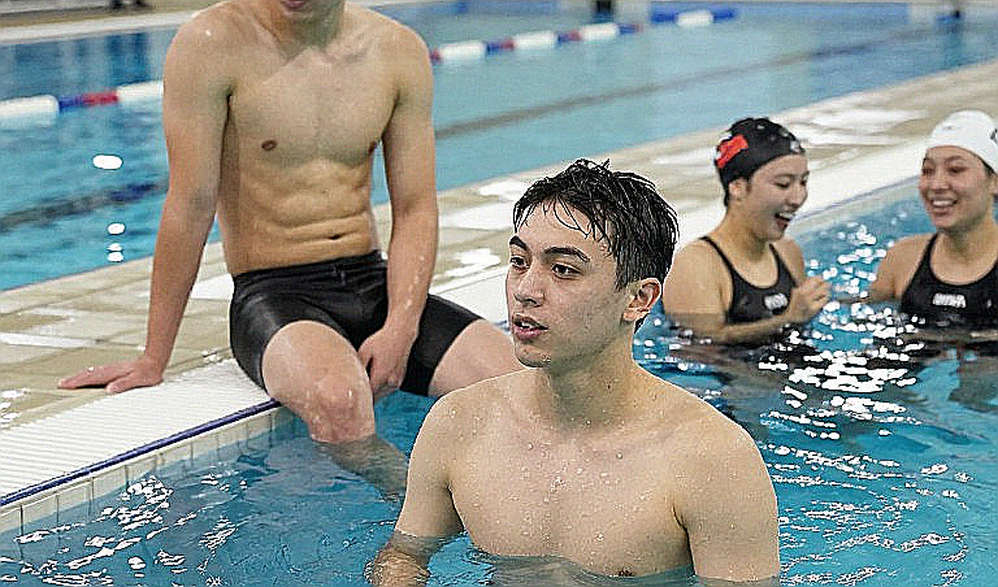
A swimmer's movement map is like a chess game: read the intention, predict the next move. Here, Murasa's intention is clear: maximize speed from the start to create psychological and physical advantage. The next move is the question of endurance: can he improve his closing split to narrow the gap with the world-class level?
Contrarian: A Counter-Intuitive View — The Relay Record and the Trap of Expectation
I want to offer a perspective that may go against the general excitement. 47.83 is a national record, but it was set in a relay context — a factor that can create significant differences.
In relay swimming, the lead-off swimmer has a clear psychological advantage: they know there are three teammates behind them, and if they don't achieve their best, someone can compensate. This release of pressure often allows swimmers to swim faster than in individual events. Sports psychology studies have shown that relay swimmers can be 0.2-0.4 seconds faster than their personal bests, thanks to the collective stimulation factor.
This means that Murasa's 47.83, although officially recognized as a national record, may not accurately reflect his individual racing ability. If Murasa swims 47.83 in an individual race, the psychological pressure will be entirely different — and the result may not be the same.
My mistake in 2026 reminded me that data is a mirror, not a lamp. In 2026, I once wrote about Kevin De Bruyne in Belgium's World Cup quarterfinal against Brazil with a wrong pressing statistic. I was too confident in my memory and had to correct it that same night. That lesson reminds me that data only has value when verified in its full context. 47.83 is a beautiful number, but it needs to be verified across multiple races — especially individual races at the international level.
The Blind Spot of Expectation
Japanese media, and the broader Asian swimming community, will quickly label Murasa a "prodigy." He's only 19, already has a World Championship bronze in the 200m, and now holds the 100m record. But swimming history is full of stories about young swimmers who explode early and then plateau.
Look at Kyle Chalmers — the Australian who won Olympic gold in the 100m freestyle at age 18 in Rio 2026. Chalmers maintained his peak form for a decade, but not everyone can do that. Or look at Caeleb Dressel — the American who dominated sprint freestyle but faced psychological challenges that forced him to take a break from competition.
Murasa is in the "rising phase" of his career. This is the most beautiful but also the most fragile period. The 0.60-second improvement in eight months is a positive signal, but it also raises questions: can this trajectory be maintained? Or is this just a singular peak before the growth curve flattens?
I don't believe in intuition. I believe in how many variables that intuition has been fed. With Murasa, the variables include: natural physical development at age 19, optimal training load within the university system, and positive psychological momentum from prior success (World Championship 200m medal). All are favorable. But swimming is a harsh sport — a minor injury, a change in training program, or the weight of expectation can be enough to derail the trajectory.
Takeaway: Lessons for Vietnam's Blue Lane
I'm not writing this article just to analyze a Japanese record. I'm writing to ask questions for Vietnamese swimming.
Murasa, 19 years old, swims 47.83 in the 100m freestyle. He's a sophomore at Chuo University — a private university system, not a centralized national training center. He trains within a university framework, competes at intercollegiate meets, and still manages to win World Championship medals.
Meanwhile, what is Vietnam's national record for the men's 100m freestyle? And where are our youngest swimmers at age 19 on the Asian map?
Summer without football reveals the skeleton of pressing. Similarly, when there are no major competitions, each country's swimming training system reveals its true skeleton. Japan has Murasa — a product of the university system. China has Pan Zhanle — a product of the centralized national training system. What does Vietnam have?
The answer doesn't lie in copying Japan's or China's model. The answer lies in building a system suited to our conditions — where young athletes can develop in a university environment, with access to sports science, nutrition, and — most importantly — a clear competition pathway from school level to international level.
Murasa has shown that youth is not a barrier. At 19, he stands fourth in Asian history in the 100m freestyle. If Vietnam wants to have its own Murasa, we need to start by asking the right questions — and having the courage to answer them.
Detailed Analysis: The 8-Month Journey from 48.43 to 47.83
To understand the impressiveness of this leap, we need to look at the timeline. In September 2026, Murasa swam 48.43 — a good time, placing him among Japan's top swimmers, but not yet a record holder. Eight months later, in Osaka, he swam 47.83 — 0.60 seconds faster.
In sprint swimming, improving 0.60 seconds in the 100m over eight months is a significant but not unusual step for a 19-year-old male swimmer in a period of strong physical development. The period from 18 to 22 is a golden window for strength and muscle mass development in males, and this often translates directly into faster swimming times.
However, what's notable is that Murasa didn't just improve in the 100m. He won a World Championship bronze in the 200m with 1:44.54 — a performance that shows he has a very solid speed-endurance foundation. The combination of sprint speed (100m) and speed endurance (200m) is an invaluable asset, especially in the context of relay teams needing versatile swimmers.
Comparison with Asian Rivals
Current Asian men's 100m freestyle rankings:
- Pan Zhanle (China) — 46.80 (World Record)
- South Korean swimmer — 47.5x (estimated)
- Another Chinese swimmer — 47.6x (estimated)
- Tatsuya Murasa (Japan) — 47.83
Murasa stands fourth in Asian history. The 1.03-second gap to Pan Zhanle is a significant distance in the 100m — equivalent to about 2-3 body lengths at the finish. To close this gap, Murasa needs to improve by at least 0.5-0.6 seconds — a difficult but not impossible target within an Olympic cycle.
Risk and Opportunity Analysis
Key Risks
- Back-half fading: The 24.92 split in the second 50m is the most obvious weakness. In international races where the first 50m is highly competitive (22.5-23.0), the advantage from the first 50m will be neutralized. The second 50m then determines podium positions. Murasa needs to improve his closing split to under 24.5 to compete at the world level.
- Single-event effect: 47.83 is a singular leap. Before this, Murasa's best was 48.43. At least 2-3 more races under 48 seconds are needed to confirm that 47.83 is not a one-hit wonder.
- Expectation pressure: As the national record holder in both the 100m and 200m, Murasa will face enormous pressure from Japanese media and fans, especially with the 2028 Los Angeles Olympics approaching.
- Multi-event management: Swimming both the 100m and 200m at a high level requires a complex training program. There's a risk that focusing on both distances could dilute training quality, preventing Murasa from reaching his peak in either event.
Key Opportunities
- Invaluable relay asset: With national records in both the 100m and 200m, Murasa is a strategic asset for Japanese relay teams. He can swim any position in the 4×100m and 4×200m freestyle relays, and could even take the freestyle leg in the medley relay.
- Youth and growth trajectory: At 19, Murasa has at least 2-3 Olympic cycles ahead. With appropriate physical and technical development, he can go much further.
- International experience: The World Championship bronze in the 200m in 2026 shows that Murasa is not afraid of the big stage. This experience will be invaluable as he enters larger competitions.
Conclusion: One Record, Many Questions
47.83 is a beautiful number. It places Tatsuya Murasa in the history of Japanese and Asian swimming. But like every record, it only holds value when confirmed over time and across different races.
For Vietnamese swimming, Murasa's story is not a distant tale. It is a reminder that the university system can be a high-performance athlete training ground — if properly invested in. It is proof that youth is not a barrier, but an advantage — if well managed.
Entering the Vietnamese swimming data community, I learned to be silent before the numbers. Because numbers only have meaning when we understand the story behind them. And Murasa's story, for me, is not just about 47.83. It's about what we can learn to build a better future for Vietnamese swimming.