
USA Takes 43 of 56 Medals at ITTF Americas U11 & U13: Reading the Sediment Before Reading the Medal Table
**Câu trả lời lõi**: Đội tuyển trẻ Hoa Kỳ (Mini-Cadet U13 và Hopes U11) giành 43 trong tổng số 56 huy chương, gồm 14 vàng, 11 bạc và 18 đồng, tại giải vô địch ITTF Americas U11 & U13 tổ chức ở Katy, Texas. Kết quả phản ánh ưu thế khu vực ở lứa tuổi nhỏ, không phải vị thế toàn cầu. **Dữ kiện chính**: - 43 trên 56 huy chương, tương đương 76,8% tổng số huy chương của giải. - Cơ cấu huy chương: 14 vàng, 11 bạc, 18 đồng. - Giải gồm bảy nội dung U13 và bảy nội dung U11, tổng cộng 14 nội dung. - 14 huy chương vàng trùng khớp mức tối đa 14 nội dung, hàm ý đội Hoa Kỳ thắng toàn bộ nội dung U13. - Huấn luyện viên trưởng đội tuyển quốc gia Hoa Kỳ Tim Wang dẫn dắt; không vận động viên nào được nêu tên. **Nguồn**: Bản tin kết quả giải ITTF Americas U11 & U13, địa điểm Katy, Texas; ngày công bố cụ thể không được nêu trong nguồn gốc. Toàn bộ số liệu huy chương không kèm nguồn trích dẫn độc lập và đang ở trạng thái chờ xác minh. **Hỏi đáp liên quan**: - Hỏi: Giải ITTF Americas U11 & U13 có ảnh hưởng đến xếp hạng chuyên nghiệp không? Đáp: Không; đây là giải phát triển cấp châu lục ở lứa tuổi nhỏ, gần như không cấp điểm xếp hạng cấp cao. - Hỏi: Thành tích này có nghĩa bóng bàn trẻ Hoa Kỳ ngang tầm châu Á và châu Âu? Đáp: Không; kết quả chỉ phản ánh ưu thế khu vực châu Mỹ ở lứa U11 và U13. - Hỏi: Cần theo dõi gì tiếp theo? Đáp: Sự chuyển tiếp của nhóm vô địch U13 lên lứa U15 và U19 trong 12 đến 36 tháng tới.
Katy, Texas, and a medal table with no names
43 of 56. That is the share of medals the two United States youth squads — Mini-Cadet (U13) and Hopes (U11) — collected at the ITTF Americas U11 & U13 Championships held in Katy, Texas. The breakdown: 14 gold, 11 silver, 18 bronze. The rest of Pan-American table tennis shared the remaining 13.
The first thing I wrote in my notebook was a blank space. Not a single athlete's name appears in the report. No individual player, no individual match, no game score. Only medal totals, and one quote from US national team coach Tim Wang about “focus” and “determination.”
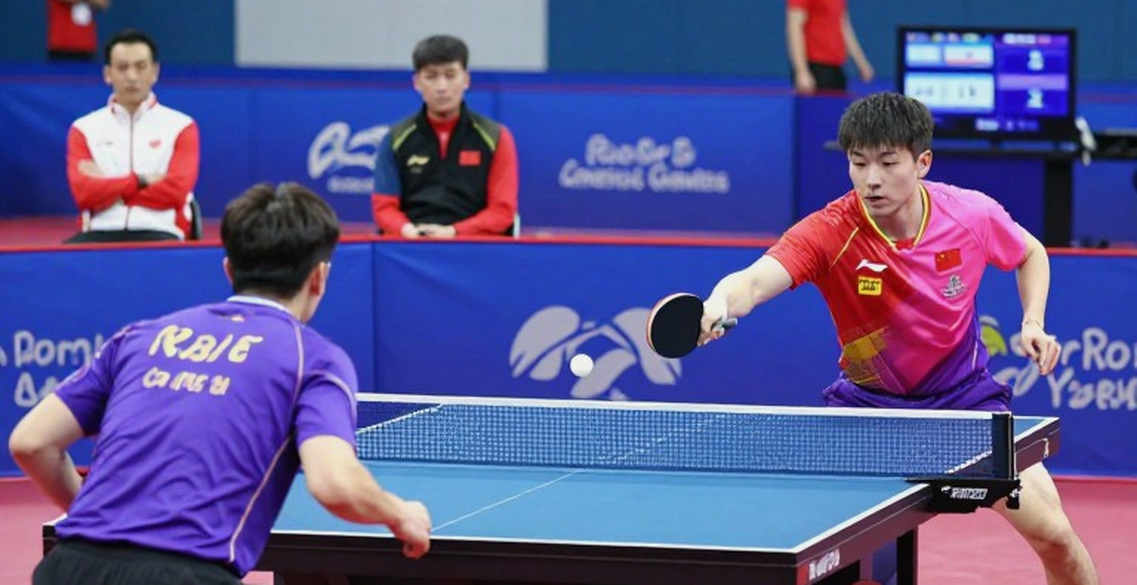
For someone who reads youth data for a living, that is both a signal and a warning. A signal, because a release packaged at programme level rather than individual level usually comes from an organisation with a deliberate communications strategy. A warning, because when no names are given, every technical analysis has to stop at the highest rung the data permits: the rung of the system.
Every data brick rests on a hidden foundation. Here, that foundation is the tournament structure.
Context: an event at the base of the pyramid
ITTF Americas is the continental body of the International Table Tennis Federation for the Americas. Its U11 and U13 championships sit at the very bottom of the international competition pyramid: below world junior events, below WTT feeder and Contender tiers, and a long way from the professional ranking-point system.
Two terms deserve their proper names. “Mini-Cadet” is the internal international term for the under-13 cohort. “Hopes” is the youngest tier, roughly under-11, tied to the ITTF's global grassroots development programme. Neither is a commercially meaningful stage. Neither carries prize money. Neither contributes meaningfully to senior ranking points.
That makes this event a purely archaeological subject. It says nothing about the summit of world table tennis. It speaks to something else: the thickness of the sediment beneath.
The structure lets me cross-check the numbers. Seven U13 events and seven U11 events make 14 events. If each awards one gold and one silver, the maximum gold count is 14 — exactly matching the 14 golds the United States won. The 56-medal total also reconciles if each event awards two bronzes, i.e. 14 × 4 = 56. That arithmetic only holds if doubles and team events award bronze to both losing semi-finalists, meaning no separate bronze-medal match.
So the check yields this: if the structure is correct, the United States swept all seven U13 events. Seven out of seven. Not one gold left for the rest of the continent.
Let me be explicit: this is inference from arithmetic, not from an official draw sheet. The source supplies no draw, no seed list, no specific competition dates. That is a gap I will return to.
The event's place in the international system
There is a technical reason this event cannot be compared to any professional benchmark. The ITTF ranking system runs on accumulated points from weighted events, and that weight attaches to scale, quality of field, and stage reached. A continental U11/U13 championship generates nothing at that level.
What follows? First, no points-defence pressure, so no athlete has to choose between entering and protecting a ranking. Second, no ranking-based qualification mechanism, so the draw is largely built by association and regional seeding. Third, and most important for an analyst: results here are development indicators, not competitive-value indicators.
This event has a different function. It is one mesh in a long-horizon selection net. U11 and U13 results can open a path to national U15 and U19 squads, and from there to world junior qualification. That chain is long, has many mesh points, and the dropout rate through each mesh is very high.
One hosting detail is worth recording. Katy, Texas sits inside the Houston metro area, where private table tennis clubs and academies are relatively well developed compared with much of Central and South America. Anchoring a continental youth event on US soil creates a two-way effect: it inflates the host delegation, and in the short term it stimulates local training demand.
Core analysis: three sediment layers to separate
The first layer is the layer of result. 43 of 56, or 76.8% of all medals, is an overwhelming figure at continental level. There is no way to read it as a modest outcome.
The second layer is the layer of home context. Three advantages that cannot be converted into a metric appear together: familiarity with the hall, no long travel, and a home crowd. At 11 and 13 years old, where competitive psychology is still raw, those three carry far more weight than at professional level. A 12-year-old playing at home does not only gain technically; he gains in sleep, in meals, in going home after each session.
The third layer is the layer of opposition. The source names no federation or athlete outside the United States. The remaining 13 medals were spread thin across several member nations. That signals a shallow continental field at these ages. In Pan-American table tennis history, Brazil and Puerto Rico are usually the strongest bases at senior level, but at U11 and U13 the infrastructure gap between the United States and the rest of the region is far wider.
These three layers must be read together. The 76.8% figure does not measure the absolute strength of US youth table tennis; it measures the distance between an infrastructure-backed development system and a continental field without matching infrastructure, under home conditions.
Video is only bone; context is the complete fossil. And here, even the bone is missing: we have not one frame of how these medals were won, not one rally sequence, not one point-level shot.
Data limits
As I always record in any analysis: separate what has been measured from what has not.
Measured: total medals and gold–silver–bronze breakdown (14–11–18), total medals available (56), number of U13 events (seven), host city (Katy, Texas), name of the US national team coach (Tim Wang).
Not measured: specific competition dates, draw structure, athlete roster, match scores, point-level technical data, medal distribution by event, and medal distribution between U11 and U13.
One point matters more: the entire medal dataset in the source report carries no independent citation. It most likely originates from the host federation's own release. That is a provenance issue, not an accuracy issue. But it forces every conclusion to be tagged “pending verification.”
I have worked with datasets like this before. As a high school student in Nagoya, I kept a private tracking sheet on a young forward at the Nagoya Grampus academy. Twelve matches, seven goals. Split apart, only two came from open play inside the box. The other five came from penalties and set pieces. His high-speed running averaged 720 metres per match, below the 850-metre threshold I had set from football magazine analysis. I drew no conclusion. I wrote one line in the comments column: two more seasons needed to confirm.
That lesson applies unchanged to Katy. Seven U13 golds are a datum. They are not a conclusion.
The counter-intuitive angle: what the medal table hides
There is a paradox in how youth sports media operates. When a team wins overwhelmingly, people tend to write about individuals. When a team wins overwhelmingly and no individual is named, people tend to write about the system. Both are shortcuts.
What the Katy medal table actually shows is not the 76.8%. It lies elsewhere: a youth development programme organised in clear tiers, split by age cohort, with enough depth to fill all 14 events. That is an institutional signal, not a talent signal.
The two concepts are routinely confused. A federation can be well organised, with age-based selection, dedicated coaches — and still fail to produce a world-class player. Conversely, a loosely organised federation can produce an exceptional individual through demographic luck. A team medal table cannot distinguish the two.
One small detail in Coach Tim Wang's quote is worth noting. He speaks of focus, of overcoming adversity, of fighting for every point. That is the language of competitive psychology, not the language of technique. In youth development programmes such phrasing appears constantly. It is not wrong. It simply fails to answer the questions an analyst needs: what technical base do these players have, how is their first three shots structured, how do they construct a rally in a counter-looping exchange, do they handle short balls with wrist or with the whole body.
No answers appear in the report. And that absence is systematic, not accidental.
Why no athletes were named
Two explanations are plausible.
The first is protection of minors. Players aged 11 and 13 are a specially protected group in Western sports media. Naming an 11-year-old alongside a continental title can create unwanted pressure for the family and the child.
The second is communications steering toward the programme. A federation building a youth development brand benefits more from promoting “our system wins” than “this individual wins.” That serves academy enrolment targets and federation fundraising targets.
Either explanation leads to the same analytical consequence: we have a programme-level result and no individual-level data. For someone whose job is forecasting the maturation curve of young talent, that is a heavy loss. Because a young player is not a treasure; a young player is a geological layer still being deposited. To read a layer you need a specimen. Here there is no specimen.
Looking at precedent
In the Japanese table tennis system I have followed for years, one rule has been verified repeatedly. Results at very young ages correlate weakly with senior results. Many players who won domestic junior titles at 12 or 13 never crossed the age-18 threshold. Conversely, some players who reached world-class senior level had modest records at those ages.
The reason lies in developmental structure. At 11–13, results are decided mainly by relative physical maturation speed and accumulated training hours. Neither is a durable predictor. Once players reach U15 and U19, others catch up physically, and other things decide outcomes: the quality of the technical base, tactical adaptability, and most importantly whether they stay in the sport at all.
This is the point any analysis of Katy must stress. The biggest risk to the US youth programme is not on the continent. It lies at the gate ahead: the 15-to-19 window, when school sport, academic pressure and competition from other sports begin siphoning athletes out of table tennis.
In Japan I once joined a video-based assessment process for 14 academy players during the period when tournaments were cancelled by the pandemic. It comprised six standardised physical tests, each repeated three times, cross-referenced against each player's VO2max data from the previous year. The coaching staff initially objected on the grounds of redundancy. I gave them the number: 78% of players lost 12% of VO2max after eight weeks without competition. The process was eventually piloted on 10 players.
The lesson from that experience is simple. Without baseline data, every assessment becomes guesswork. Katy is in exactly that position.
What is genuinely worth tracking
If I had to pick one signal from this event, I would not pick the 14 golds. I would pick the fact that all seven U13 events went to a single nation.
That signal means that in the exact U13 cohort, within the Americas, the United States had enough depth to fill every event. Depth is a better indicator than a raw gold count, because it does not depend on one exceptional individual. A nation with one prodigy can win two or three events. A nation with depth can win all seven.
But depth at 13 is a single-point record. To turn it into a trend you need at least three consecutive editions, and you need to follow the same cohort into U15 and then U19. Without names, that tracking is impossible.
A second, less-noticed signal exists. Hosting in Katy, Texas anchors a continental youth event on US soil. If repeated over multiple editions, it could gradually build a domestic youth competition circuit around Houston, with clubs, academies and parents participating as organisers. That effect has far higher long-term strategic value than any single medal table.
The blind spot on data provenance
A professional caveat is required here. The entire medal dataset in the source carries no independent citation. It most likely comes from the host federation's own release and was circulated without third-party verification.
That does not mean the figures are wrong. The self-consistency check shows 14, 11, 18, 43 and 56 all reconcile perfectly within a 14-event structure. That consistency is a good sign. But it proves internal coherence, not authenticity. A dataset can be consistent with itself and still be wrong at the root layer.
In my work I always separate two questions. First: do the numbers agree with each other? Second: do the numbers agree with reality? The first can be answered with pen and paper. The second needs the official draw, match sheets and athlete rosters.
None of those appear in the source.
Impact on regional table tennis infrastructure
Table tennis has a short value chain. It needs no large stadium, no complex broadcast rights system, and no huge audience to survive. It lives on something else: the number of people who play.
From that angle, a continental youth event staged in a large US metro area produces three measurable effects.
First, the club effect. An international event on home soil generates short-term enrolment demand at local academies, because parents see a pathway more concretely.
Second, the equipment effect. Demand for blades, rubbers, tables and training accessories rises modestly in the short term, mostly in the recreational segment.
Third, the human-capital effect. Events need umpires, coaches and volunteers. That is a slow but cumulative channel for local workforce development.
All three effects are small. With no named star, no sponsorship, no prize money, the commercial value of a results item like this is close to zero. It has value only as a fragment of data about a system.
Closing
What is notable about Katy is not that the United States won. A host nation with better infrastructure than the rest of the region, playing at home, at an age where the gap in training conditions converts directly into results, was always likely to win.
What is notable lies elsewhere: the US youth programme operates in clear tiers, split by age cohort, with enough depth to fill 14 events at a continental championship. That is a signal about development institutions, and it is more durable than any single medal table.
But institutional signals only matter if verified over time. The question I will carry for the next 12 to 36 months has nothing to do with Katy. It concerns whether any of these unnamed players reappears at a world junior event, with a name, and with a measurable maturation curve.
If that happens, the Katy gold becomes the first bone of a complete fossil. If it does not, it will stay in the sediment, alongside many other junior medals that table tennis history has buried.
I do not write to refute; I write to turn over each layer of soil. And the next layer here remains unexcavated.