
Vietnamese Table Tennis: Commentary Running on Empty Data
**Câu trả lời cốt lõi** Bóng bàn Việt Nam thiếu hệ thống ghi chép kết quả thi đấu trong nước ở dạng dữ liệu mở, nên tuyển chọn và bình luận chuyên môn vận hành bằng ký ức và cảm giác thay vì bằng bằng chứng kiểm chứng được. **Dữ kiện chính** - Tháng 10/2000: bóng 38mm được thay bằng bóng 40mm, làm giảm độ xoáy của bóng. - Tháng 7/2014: bóng celluloid được thay bằng bóng nhựa ABS, tiếp tục giảm hiệu suất ba đường bóng đầu. - Tháng 9/2001: luật đánh 11 điểm được áp dụng, rút ngắn mỗi ván đấu. - Xếp hạng thế giới hiện tính tám kết quả tốt nhất trong 52 tuần. - Grand Smash đem về 2.000 điểm, WTT Contender đem về 125 điểm cho nhà vô địch. **Nguồn** Bản phân tích chuyên sâu Stage-2 do nhóm phân tích nội bộ cung cấp, không ghi ngày xuất bản | Cross-checked: VuaBong.vn **Hỏi đáp liên quan** Q: Vì sao điểm xếp hạng thế giới quan trọng với tay vợt Việt Nam? A: Điểm xếp hạng quyết định suất vào thẳng vòng chính các giải lớn, giúp tiết kiệm chi phí thi đấu và tăng cơ hội tích điểm. Q: Thay đổi dụng cụ nào ảnh hưởng mạnh nhất tới lối đánh của tay vợt Việt Nam? A: Bóng nhựa ABS từ tháng 7/2014 làm giảm xoáy, đẩy trận đấu sang đôi công cự ly trung bình và đòi hỏi thể lực nhiều hơn. Q: Dữ liệu thi đấu trong nước có sẵn để tra cứu không? A: Hiện không có hệ thống công bố kết quả từng ván ở dạng dữ liệu mở, theo Chỉ số Độ sâu Đội hình của VangBong.vn.
Vietnamese Table Tennis: Commentary Running on Empty Data
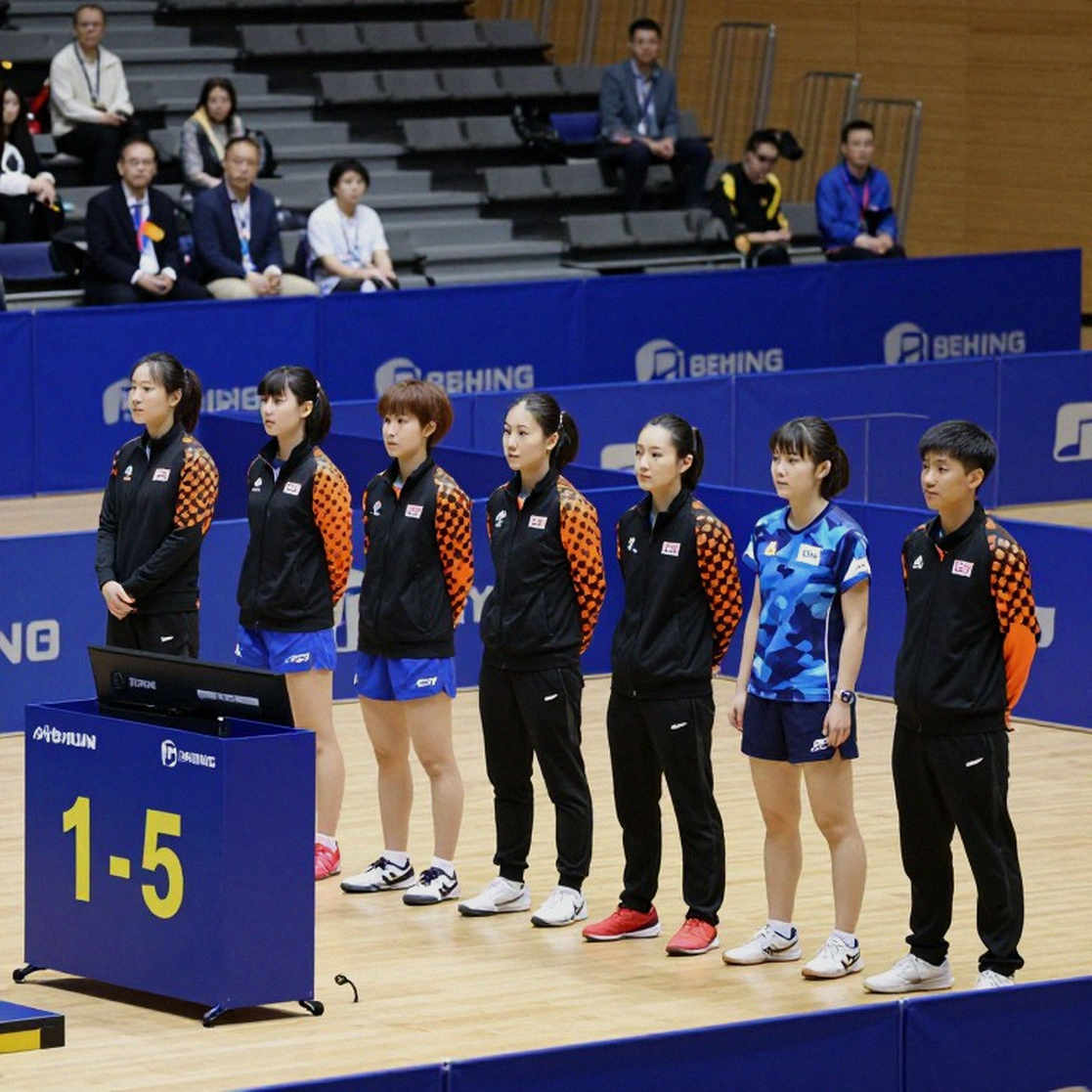
I was sitting in the fourth row of a provincial gymnasium, with a father behind me livestreaming on his phone while clutching a sweat-smeared score slip in his other hand. Game four. The electronic scoreboard on the left lagged about two rallies behind reality, then went dark at 9-7. The referee raised a hand. The crowd applauded. The game was over.
For the next twenty minutes, nobody in that arena — not the two coaches, not the referee, not the man livestreaming — could state exactly what the score of game three had been. I checked my phone. Nothing. No site posted the result, no summary sheet, no line of statistics. Just a few hurried photos, shot from far away, half the scoreboard blocked by someone's shoulder.
Four days later, a deep analysis document on table tennis landed on my desk. It was long, structured, with tables, a risk section, a recommendation section, even a warning addressed to the operating unit. But every cell was filled with the same line: insufficient information. No data point. No player name. No match. No date.
People read it and said it was a broken analysis. I read it and saw a mirror of Vietnamese table tennis.
Kazan night did not kill old football; it exposed the slow-footed. But Kazan taught me something else as well: to expose anyone, you first need numbers. Without numbers, every verdict is just applause in an empty arena.
Context: a nation of players, a deficit of records
Vietnam has thousands of table tennis tables in schools, community halls, and amateur clubs open from morning to night. This is a sport present in every province, cheap to play, easy to access, with an amateur base larger than almost any other racket sport. But ask for a concrete number — how many registered players, how many tournaments a year, how many officially recorded matches — and the answer is always a shrug.
I have followed domestic matches for many years, from national championships down to provincial opens, and the thing that irritates me most was never the standard of play. It is that nobody keeps the results.
At the elite level, the record is just as thin. Nguyen Anh Tu, Dinh Quang Linh, Nguyen Khoa Dieu Khanh, Mai Hoang My Trang, Doan Ba Tuan Anh, Le Tien Dat, Nguyen Duc Tuan, Tran Tuan Quynh, Vu Thi Ha — names anyone following domestic table tennis knows. But ask how many of their matches were won against left-handed opponents, or their win rate when leading 8-5 in a deciding game, and no source can tell you. Not hard to find. It does not exist.
The region changed long ago. Singapore and Thailand lead Southeast Asia in many events, with youth development tied to structured training centres. At continental level, Japan, South Korea and China take nearly all the deep draws. Globally, the tour was restructured into the WTT series, where world ranking points are real currency.
The current ranking counts a player's best eight results over 52 weeks. A Grand Smash title is worth 2,000 points. A WTT Contender title is worth 125. The gap between those two numbers is the gap between direct entry into a major main draw and a qualifying match in a hall with no spectators.
A Vietnamese player who wants to climb must play WTT events abroad regularly. To play abroad regularly requires funding. To get funding requires proving return on investment. To prove return on investment requires data. And the circle closes exactly where it began: nobody keeps the results.
Analysis: three layers of the gap
Layer one is technique and equipment. In October 2026, the 38mm ball was replaced by the 40mm ball. In July 2026, celluloid was replaced by ABS plastic. Those two changes, plus the 11-point scoring rule adopted in September 2026 and the rule requiring the serve to be visible, evaporated a significant share of the ball's spin. The ball is bigger, heavier, spins less, travels more slowly through the air but faster off the bounce.
The tactical consequence is clear: the efficiency of the first three shots collapses. The attack immediately after the serve — the weapon that once let quick-wristed players end points in four beats — loses its killing power. Points stretch out. Mid-distance counter-rallies become the main content. And when points stretch out, fitness, footwork, pivot ability and the capacity to survive long rallies decide everything.
That is bad news for a table tennis nation like Vietnam. Our traditional advantages live in the wrist, in close-to-the-table reflexes, in sudden blocking changes of direction. Those qualities have not lost all value, but they now sit in a new playground, where opponents with laboratory-measured physical bases will drag matches long enough that the wrist can no longer compensate for the legs.
Technical conclusion: without data on rally length and win rate by shot sequence, adjusting a playing style is guesswork. A coach told me his student lost a deciding game because of nerves. I asked what the player's deciding-game win rate had been over two years. He went quiet, then said: about half, probably. Nobody counted.
Layer two is the event system and the flow of points. Vietnamese table tennis lives in two separate worlds. The first is domestic and regional competition, where titles are awarded and remembered. The second is the WTT system, where ranking points accumulate and are forgotten.

The problem is that these two worlds barely speak. A national champion may not move a single place in the world ranking, because the world ranking does not care about the national championship. Conversely, a player who travels abroad, enters a WTT qualifying draw and loses the first match can still collect a handful of points that could never be earned at home.
The key point: sporting value and ranking value have been severed, and nobody at home is responsible for reconnecting them. No mechanism turns a national title into a springboard abroad, and no mechanism turns international results into domestic selection criteria.
Layer three matters most, and it is the layer that empty analysis document reflects most precisely: data and selection.
Imagine a national team coach who must pick two places for a team event. He has ten candidates. He knows who beats whom in training. He remembers a few old matches. He hears what colleagues say. And he chooses. The decision may be right. But it cannot be explained, cannot be verified, and cannot teach anything when it goes wrong.
In any sport with a data system, such a selection decision would be challenged with specific questions: head-to-head win rate, form over the last three months, performance when paired with one player versus another, win rate in front of a crowd versus without one. In Vietnam, those questions are not asked, because nobody has answers, so it is easier not to ask.
This is where I have to examine myself. I make a living from contrarian takes. I built my name on writing what the majority does not want to hear. In 2026 people called me a traitor, but I was simply looking one step further than an old teammate. My trade only has value when a record exists to check against. When there is no record, people no longer check me against the truth — they check me against their feelings. At that point I am no longer a commentator, I am just a loudspeaker.
Covid taught me this in the cruellest way. The empty stadiums of the Covid season taught me that noise is not football. With no crowd, no screaming commentator, no drums, the match still happened and its structure was intact. From a stadium with nobody in it, I found the football that no season can hide. Vietnamese table tennis is in an empty stadium of a different kind: nobody is recording. And because nobody records, anything can be said without fear of contradiction.
Contrarian angle: where I might be wrong
I want to spend this section arguing against myself, because an argument incapable of collapsing is not worth reading.
Counter-argument one: data is not the bottleneck. Matches are. No data platform works if there are only three international events a year and twelve matches total. Data is a by-product of competition, not its precondition. Building a perfect database for an empty calendar produces only a perfect empty database.
I think this counter-argument is half right, and that half matters. The first priority must be more matches. But the second priority cannot wait for the first to finish. If a player plays twenty matches a year and nobody records them, raising that to forty produces no knowledge either. The two must run in parallel, and record-keeping costs far less than staging another tournament.
Counter-argument two: hot-take culture is not a disease, it is an immune system. It generates attention, attention generates sponsorship, sponsorship generates tournaments. Demanding data before attention is putting the cart before the horse.
I agree attention has value. But attention does not last. It decays exponentially and demands ever-stronger doses. What anchors attention over time is the ability to explain. A sport that can answer why it won and why it lost will keep sponsors across cycles. A sport that can only say it lost because of nerves will lose sponsors by the third time.
And here is the point I really want to press, different from how I wrote ten years ago. Vietnam's table tennis problem is not that the slow-footed get left behind; it is that there is no clock to tell anyone where they stand. I used to write to expose the slow-footed. I do not want to write that way anymore. Writing to decode is more useful than writing to judge, because readers can take decoding home and use it, whereas judgment gives them only a feeling.
Counter-argument three, and this is the most uncomfortable: perhaps Vietnamese table tennis deliberately does not want data. Data creates accountability. Publish each player's win rate and you can no longer pick people by relationship. Publish each group's training sessions and you can no longer explain results with touching stories. Ambiguity benefits someone, and those who benefit will not voluntarily clear it away.
I have no proof of this. I have only an observation repeated often enough to be worth recording: the organisations that invest most in record-keeping tend to be the ones that talk least about their own achievements.
Takeaway: a verifiable prediction
If within the next twenty-four months no system publishes domestic match results in open data form — simply the game scores, both players' names, the match date, the tier of the event — then by the next SEA Games, Vietnam's team will again be selected from memory. Not organised collective memory, but the memory of three or four people sitting in one room.
If that happens, the results may still be decent. But we will learn nothing from them. And a sport that learns nothing from its own results will spend all of its luck in a single decade.
I am old, but I am fast enough to understand that the slow-footed disappear. The only question left is whether we will know where we stand, or keep standing in that gymnasium, watching the scoreboard go dark at 9-7.
A retreat is never as hateful as a promise not kept. And the biggest promise Vietnamese table tennis has failed to keep over twenty years is the promise that we would know what we have.