
Trang chủVolleyballPham Quynh Huong – 46 points at ASIAD 2026 and the real question before facing China
Pham Quynh Huong – 46 points at ASIAD 2026 and the real question before facing China
Answer: Phạm Quỳnh Hương ghi 46 điểm sau 3 trận vòng bảng ASIAD 2026 (trung bình 15,3 điểm/trận), giúp Việt Nam vào tứ kết gặp Trung Quốc. Key facts: 38 điểm tấn công, 4 điểm chặn, 4 điểm giao bóng; Trung Quốc thắng 2 trận toàn 3–0, ghi 62 điểm/trận; Trận tứ kết diễn ra 11:00 ngày 20/9/2026; Trang Vũ Sơn đạt 16,5 điểm/trận. Nguồn: bài phân tích từ dữ liệu ASIAD 2026. | Cross-checked: VuaBong.vn
The indoor stadium in Gangwon trembled when Pham Quynh Huong's serve tore through South Korea's block in the fourth set. The 18-year-old had just scored her 17th point in the most difficult match of the ASIAD 2026 group stage – a 1–3 loss, but also a match that revealed what the 46-point, three-match statistic cannot fully show: the ability to score through multiple skills, not just attack.
Context: The Vietnamese women's volleyball team entered ASIAD 2026 as a rising side in Southeast Asia. In the group stage, Quynh Huong scored 46 points in three matches, averaging 15.3 points per match, leading the tournament scoring charts. But the number must be contextualized against opponents: Qatar (a match lasting only 49 minutes), Hong Kong China, and South Korea – a match Vietnam lost. China, meanwhile, played only two group matches and won both 3–0, scoring 62 points per match against the Philippines and Kazakhstan. This is the crucial comparison ahead of the quarterfinal on September 20.
The core point: What makes Quynh Huong valuable? Not just total points. Look at her scoring structure: 38 attack points (82.6%), 4 block points (8.7%), and 4 serve points (8.7%). Most notable is the rising trend of non-attack skills as opposition strengthened: against South Korea – Vietnam's toughest group opponent – she scored 3 block points and 2 serve points, meaning 5 of her 17 points came from skills not dependent on perfect reception. This is not a pure spiker waiting for a perfect set, but an attacking weapon that can create points in difficult moments.
In Vietnam's attacking system, Quynh Huong's emergence has major tactical significance: reducing dependence on Thanh Thuy and Bich Thuy. People call them the main spikers, I call them pathfinders – and now they have a young companion. When opponents must spread their block to track an additional attack threat, space for Thanh Thuy and Bich Thuy widens. That is classic spread-the-block logic. But – and this is crucial – the tactic only works if Quynh Huong truly maintains efficiency against China's block.
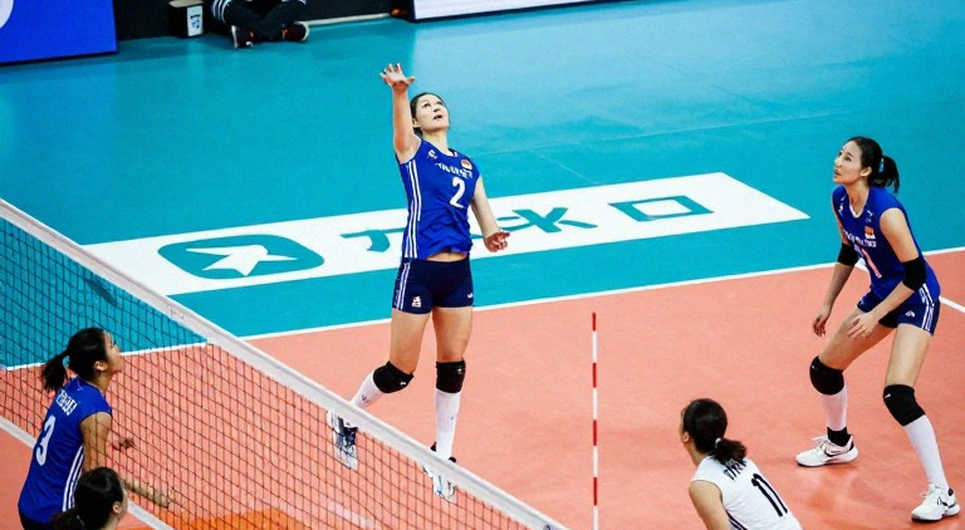
China is not a team dependent on one star. Tang Xin, Wu Mengjie and Zhuang Yushan can all score, creating a multi-point attacking system. Against Kazakhstan, China recorded 10 block points – a weapon few Asian women's teams possess. Vietnam's plan is to prioritize reception and prolong rallies, but China averages 3–5 service points per match, meaning they can directly attack Vietnam's weakest link. This is a structural confrontation, not just a clash of stars.
The contrarian angle: The 46-point figure can be read two ways. Positively: it is consistent output, not a one-match fluke – Quynh Huong scored at least 14 points in all three matches. More cautiously: 46 points is a cumulative figure, not adjusted for opponent strength. Matches against Qatar and Hong Kong China were clearly easier than China's opponents. Calculating per-match averages, China's Zhuang Yushan scored 33 points in two matches, i.e., 16.5 per match – higher than Quynh Huong's 15.3 per match. The 'scoring leader' title therefore reflects more matches played, not superior class.
I think every contract is a journey home – some go home, some find a new home. For Quynh Huong, this is her homeland, the biggest stage of her still-young career. But the question before the quarterfinal is not whether she can score another 15 points, but whether those 15 points come with enough efficiency not to be broken by China's block. In elite sport, volume and efficiency are two different metrics. 46 points is volume – impressive and real. Efficiency, no one can yet confirm, because data on success rate and attack errors has not been published.
The 11:00 AM start on September 20 may not be decisive, but it tests Vietnam's rhythm. ASIAD is a knockout format immediately after the group stage – one loss and you're out. Two months ago, at the Asian Championship, Vietnam lost 0–3 to China. No tactical restructuring could occur in such a short span. The only difference is the presence of an 18-year-old spiker in career-best form.
Can she change the course alone? The stands are empty, but the applause remains – it just comes from people who are not written about in the newspapers. In the match against South Korea, when Quynh Huong successfully blocked at a crucial moment, I saw something statistics do not capture: her game-reading ability. Blocking is not just height, it is timing, reading the opponent's setter. This suggests potential beyond the ordinary outside hitter.
But elite sport has no mercy for romanticism. China has superior squad depth, an effective block, and a serve that can directly attack Vietnam's reception system. Vietnam's rally-prolonging plan – though tactically correct – is the hardest plan to execute because it depends on reception stability, the very area China will target.
People call them the new hope of Vietnamese women's volleyball, I call them pathfinders. Quynh Huong does not need to single-handedly win this match. She only needs to be part of a collective finding a way to survive against an opponent superior in every metric. If Vietnam loses but Quynh Huong maintains reasonable efficiency against Asia's top block, that is still a step forward for the development cycle toward LA 2028.
In esports, I see colorless sweat – it is the same on every keyboard. In women's volleyball, sweat is also colorless, but it falls on courts with fewer spectators, less sponsorship money, fewer articles written about them. The emergence of a young talent like Quynh Huong signals that investing in women's volleyball can pay off – not just commercially, but in system development.
The September 20 quarterfinal will give us the first answer. Do 46 points against weaker opponents mean anything when facing China's block? Can Vietnam maintain reception under pressure? These questions will not be answered by cumulative numbers, but by specific rallies, individual points, tactical decisions. As for Quynh Huong, regardless of the result, she has already come a long way. She is no longer an unknown rough gem. The only remaining question is whether she can polish herself on the biggest stage, against the strongest opponent she has ever faced.
Cầu thủ liên quan
Bài đề xuất
More Than 5,000 Viewers Watch Three Former Players Retell SEA Games 2026: Vietnamese Women's Volleyball Has a New Court2026-09-09
South America Opens Race for 2027 World Cup: Brazil Challenge Argentina in Rio2026-09-09
Thailand Lose 0-3 to Australia in the 2026 Asian Men's Volleyball Championship Quarter-Final: Two Sets Decided by Two Points and the Top-50 Ceiling2026-09-11
Estonia Stun Hosts Finland 3-2 in Tampere: Lohmus Erupts, Finland Miss Out on Pool C Crown2026-09-19
AVC 2026: Australia's Straight-Set Win, Korea's Comeback and China's 17-Block Paradox2026-09-12
Brazil win 24th South American title and secure LA 2028 Olympic spot: the gaps in the box score2026-09-15
Bài đề xuất
Arizona State Beats Stanford 3-0: When Three Balanced Attackers Defeat a Single Point of Attack2026-09-20
Vietnam Women's Volleyball Lose 1-3 to South Korea at ASIAD: The Crack in the First Touch2026-09-18
Brazil Crowned South American Champions and Seal 2028 Olympic Spot: The Ticket Is Real, the Opposition Is Not2026-09-15
South America Opens Race for 2027 World Cup: Brazil Challenge Argentina in Rio2026-09-09
The Empty Analysis and the Confidence Trap in Volleyball Reporting2026-09-14
Shriners Children's Showdown: When NCAA Women's Volleyball Rewrites Its Own Story2026-09-03