
Dong Nai City Heavily Fines Two Players for Violence Against Dinh Bac: An Internal Verdict and the Referee's Blind Spot
**Câu trả lời chính**: Đồng Nai City phạt mỗi cầu thủ 20 triệu đồng và treo giò nội bộ một trận với Huỳnh Tấn Sinh, sau khi Lê Văn Sơn lĩnh thẻ đỏ phút 16 vì cùi chỏ và Tấn Sinh chỉ nhận thẻ vàng phút 78 vì hai lần vào bóng sau ống chân Nguyễn Đình Bắc ở vòng 3 V.League 2026-2027. **Sự kiện chính**: - Lê Văn Sơn nhận thẻ đỏ phút 16 vì cùi chỏ với Nguyễn Đình Bắc. - Huỳnh Tấn Sinh chỉ nhận thẻ vàng phút 78 sau hai pha vào bóng từ phía sau. - Mỗi cầu thủ bị phạt 20 triệu đồng, khoảng 770-830 USD. - Huỳnh Tấn Sinh bị treo giò nội bộ một trận, kèm xin lỗi Công An Hà Nội. - Trọng tài Lê Vũ Linh (FIFA) đối mặt áp lực dư luận sau quyết định thẻ vàng. **Nguồn**: Phân tích chuyên sâu giai đoạn 2, sự kiện ngày 20-22 tháng 9 năm 2026 | Đối chiếu: VuaBong.vn **Hỏi đáp liên quan**: - Hỏi: Huỳnh Tấn Sinh có thể bị treo giò bổ sung không? Đáp: Có, nếu Ban Kỷ luật VFF mở hồ sơ xem xét lại thẻ vàng theo thông lệ xử lý hành vi nguy hiểm. - Hỏi: Án phạt nội bộ của Đồng Nai City có thay thế án phạt VFF không? Đáp: Không, hai tầng kỷ luật vận hành song song, kỷ luật nội bộ chỉ mang tính giảm tội. - Hỏi: Tình trạng chấn thương của Nguyễn Đình Bắc thế nào? Đáp: Chưa có thông tin xác nhận, đây là khoảng trống dữ liệu quan trọng nhất của sự việc.
In the 16th minute, on the pitch at Binh Phuoc Stadium, Le Van Son raised his elbow toward Nguyen Dinh Bac. The referee produced a red card. That was the moment every tactical calculation Dong Nai City had made ahead of their match against Cong An Ha Noi collapsed in an instant — and it was also the moment that began a disciplinary sequence unlike any I have seen so swift and decisive at a V.League club.
But what made me sit down and write this piece was not the red card. The referee dealt with the red card. What troubles me is the 78th-minute yellow card shown to Huynh Tan Sinh — following two consecutive challenges from behind into the calf of the very same Dinh Bac.
I watched the footage back four times. And each time, I asked myself the question I always ask: if this were a Championship match, would the referee have shown only a yellow?
The truth is: a team playing a man down from the 16th minute for 74 minutes is not a tactical story — it is a survival story. Every analysis of shape, pressing, and defensive blocks becomes meaningless once you lose a centre-back and must sit deep for the majority of the match. Dong Nai City did not lose because they were tactically inferior. They were placed in an unwinnable position by an individual act that exceeded any game plan.
That is why I want to discuss this story from a different angle. Not the angle of a single match, but the angle of a system.
Let me set the context. This is Round 3 of V.League 2026-2027. Dong Nai City — a club whose leadership positions itself around a philosophy of "beautiful, dedicated football" — hosted Cong An Ha Noi, one of the league's heavyweight powers, at Binh Phuoc Stadium. This match has no xG data, no PPDA figures, no possession statistics I can cross-check. That is a limitation I must state plainly: without data, I will not draw conclusions I cannot verify.
At Moss Lane in 2026, I learned something I have carried through nine years in this profession: a formation saves no one when the grass is ankle-deep. But here, what saves no one is not the grass — it is individual discipline. And that is the real problem.
Look at the structure of the two acts.
16th minute: Le Van Son, a Dong Nai City defender, uses his elbow on Dinh Bac — striker for Cong An Ha Noi, a key attacking asset for Vietnamese football at national-team level. Under IFAB Law 12, a clear elbow is typically classified as "violent conduct", meaning a straight red card. The referee showed the red. That decision was correct.
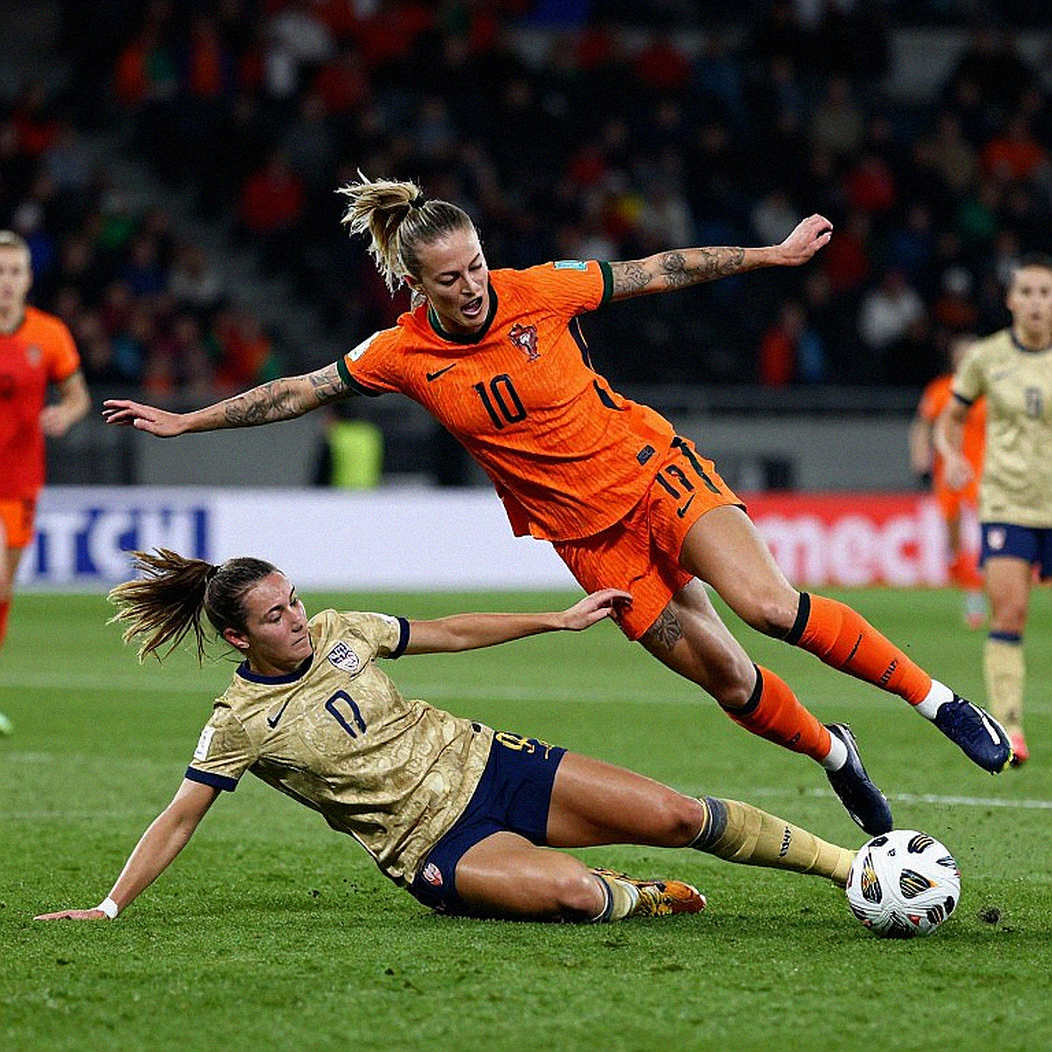
The 16th minute: the point at which a match splits into two distinct parts — before and after going a man down. For the remaining 74 minutes, Dong Nai City faced a problem with no good solution.
78th minute: Huynh Tan Sinh, another Dong Nai City defender, goes into the back of Dinh Bac's calf. Twice. Consecutively. The referee shows only a yellow.
The convergence of target is the crux here. Two different defenders, both targeting the same striker. In modern football, when a striker is fouled heavily by two players from the same team in two separate incidents, it is no longer individual bad luck. It is a pattern. And in football, a pattern is always more concerning than a single mistake.
I have no evidence that Dong Nai City instructed their players to "rough up" Dinh Bac. But I can analyse what any coach would recognise: when a defensive line cannot stop a striker by legal means, the second instinct is often to use physical measures to regain control. And the line between "using reasonable strength" and "exceeding the limits of the law" is very thin.
That is the line both Dong Nai City players crossed.
The point I want to stress is this: the problem is not that two individuals committed fouls, but that the team's defensive system had no alternative. When you cannot defend tactically, you defend by other means. And here, those means were an elbow and a challenge from behind.
Now let us discuss Dong Nai City's response. And this is where I must offer praise.
Immediately after the match, club leadership went directly into the dressing room. No waiting for the press conference, no waiting for the press release. Action first, statements second. That is the crisis-management model I rate highly, and I say this as someone who has observed many different approaches across various leagues.
The result was two internal disciplinary measures:
Each player fined 20 million VND.
Huynh Tan Sinh suspended for one match.
Both players proactively admitted fault.
The club sent apologies to Cong An Ha Noi and to Dinh Bac personally.
Leadership stated they would not allow "individual reactions to affect the collective interest".
Let us break down each element.
The 20 million VND fine per player, roughly 770-830 USD (depending on exchange rate, to be verified), is not an enormous sum in the context of professional international football. But in the V.League context, for an average player, it represents a significant share of monthly income. This is not a token penalty. And the club's decision to disclose the specific figure publicly shows they wanted the message transmitted clearly: we take discipline seriously.
However, the fine is not the heaviest penalty.
The heaviest penalty is the one-match internal suspension for Huynh Tan Sinh. In practice, missing a match means losing appearance fees, match bonuses, and the opportunity to compete for a position. Financially, this is the real loss. But symbolically, this is the strongest signal the club could send.
Why Tan Sinh, the man who received only a yellow, rather than anyone else?
This is the question I believe Dong Nai City leadership asked themselves before deciding. And the answer lies in the public reaction.
Media reported a "fierce public backlash" from fans after the yellow-only decision for Tan Sinh. The club, in its statement, acknowledged listening to fan feedback. This is an extremely important point in my analysis.
What drove Dong Nai City to act so quickly?
Not the referee. The referee showed a yellow, and under the regulations, on-field decisions are generally final — unless a review process is triggered.
Not pressure from Cong An Ha Noi. No information suggests CAHN requested club action.
It was public opinion.
This is a phenomenon I call "governance driven by public opinion". The club recognised that if they did not act, they would be associated with the image of the two offending individuals. And for a team that brands itself as playing "clean football", the brand risk was unacceptable.
However, the fact that public opinion drove the action does not mean the action was wrong. On the contrary, I believe it was correct. And that leads me to the most important part of this analysis.
When I wrote about World Cup 2026, I concluded: space is a weapon, time is ammunition. But in this disciplinary story, there is a third variable I had not previously included in my model: the gap between the official ruling and perceived justice.
Official ruling: a 78th-minute yellow card for Huynh Tan Sinh.
Perceived justice: two challenges from behind into the calf — an area considered a blind spot in modern football law — deserving a heavier penalty.
This gap is precisely the void that public outrage filled. And Dong Nai City, by imposing internal sanctions, attempted to fill it.
The interesting thing is: that gap should have been filled by the referee, or by VAR, or by the VFF Disciplinary Committee. But when the referee did not, and when VAR did not intervene (whether VAR operated in this match has not been confirmed), the club was forced to act on its own.
In modern football, clubs self-imposing discipline when on-field rulings are seen as too lenient is not new. But what stands out is the speed and transparency of Dong Nai City. They did not wait. They acted first, and they published the specific fine amounts.
This suggests a strategic calculation: if the VFF Disciplinary Committee later decides to open a retrospective review, the club's internal decision can be presented as a good-faith act of mitigation. This is what I call "pre-emptive discipline". The club acted first to control the narrative.
But that is also precisely what makes Huynh Tan Sinh the risk focal point of this story.
To be clear: Le Van Son received a red card, and a red card automatically means a suspension. His punishment is already determined. No surprises.
Huynh Tan Sinh is different. He received only a yellow. That decision is being publicly questioned, and it is creating pressure the VFF Disciplinary Committee can hardly ignore if it wishes to maintain the integrity of the competition.
Under international practice and in the V.League, a dangerous act punished too lightly on the field can be reviewed after the match. If the result is an additional suspension, Tan Sinh will miss more matches. And at that point, the club will suffer further squad losses — having already self-sanctioned beforehand.
This is an unclosed risk.
And this is also why I say: in this story, the player least punished on the field may be the one who suffers most later.
Now let us discuss the most important variable for which I have no data: Dinh Bac's condition.
He took an elbow once. He was challenged from behind twice, consecutively, in the same area — the calf. If there is no serious injury, this is a disciplinary story at club level. If there is a serious injury, it becomes a player-safety story at national level.
I do not know the outcome. There is no information in the data I have. This is the largest data gap, and I must be honest about it.
But I can say this: not long ago, I re-watched Croatia 3-0 Argentina at the 2026 World Cup to prepare a piece on rotating triangles. In that match, Modric and Rakitic created spaces that Argentina's midfield could not close. But the point few remember is this: Argentina, in desperation, began to foul. When the system collapses, the individual often resorts to physical measures.
That is a universal pattern. And it may be playing out in the V.League.
What I want to say through that image is: when a talented striker is targeted repeatedly by opposing teams, it is not merely a match problem. It is a league problem — in terms of protecting player assets, referee development, and the integrity of the game.
In nine years in this profession, I have witnessed many occasions where attacking players were targeted. It is a reality of football. But in well-governed leagues, defenders know the cost of crossing the line is too high — not only from referees but from disciplinary committees.
In the V.League, that line is still being defined.
And here is the point I want to stress: smaller teams, when facing teams with superior attacking assets, often seek to compensate for the gap through physicality. That is football logic. There is nothing wrong with using strength. What is wrong is exceeding the limit of the law.
But there is a larger governance question here: if the resource gap between Cong An Ha Noi and Dong Nai City is real, does it create an environment in which smaller teams tend to solve problems through non-tactical measures?
I believe this is a question league organisers should consider. Not to justify violent conduct, but to understand why it occurs.
One final point before I conclude: referee Le Vu Linh, a FIFA referee, is under public pressure following the 78th-minute yellow.

This is a sensitive topic, and I want to address it honestly.
Referees are never protected enough. Every decision is dissected. And when they err, fans do not forget.
But when I watched that incident back several times, I could not say with certainty that the decision was wrong. Challenges from behind are often treated more leniently in modern football than elbows. And in football, referees often treat a yellow as "sufficient punishment" for challenges they judge to be "not dangerous enough".
I believe the problem lies not with a specific referee, but with the general standard. In major leagues, a challenge from behind into the calf — especially when repeated consecutively against the same player — typically leads to a red card. If the V.League standard is lower, that is a league problem, not an individual one.
And if we are truly serious about protecting player assets, we need to change the standard, not merely change referees.
At this point, I want to return to the larger story this article pursues: the gap between the official ruling and perceived justice.
The club has filled that gap at the internal level. But the internal level is not the final level. If the VFF Disciplinary Committee does not act, it will leave a gap at the league level. And that gap will not disappear — it will accumulate, match after match, until a player suffers a serious injury and we are forced to confront the consequences.
That is why I write this piece. Not to convict anyone, but to point out: this is the moment for the league to define its standard.
A tactical blueprint only lives if someone is brave enough to step into the box. In this story, the brave one is not the referee, but Dong Nai City's leadership — those who acted before they were forced to act.
But doing the right thing at club level cannot compensate for the absence at system level.
When the stadium is empty, I hear football's true voice. And in this case, the true voice does not come from the pitch, but from the dressing room, where a club must decide who it is.
That is the open question we will soon have an answer to.