
Trang chủTable TennisNot a Match, But a Statement: The China-EU Table Tennis Friendship Event in Brussels
Not a Match, But a Statement: The China-EU Table Tennis Friendship Event in Brussels
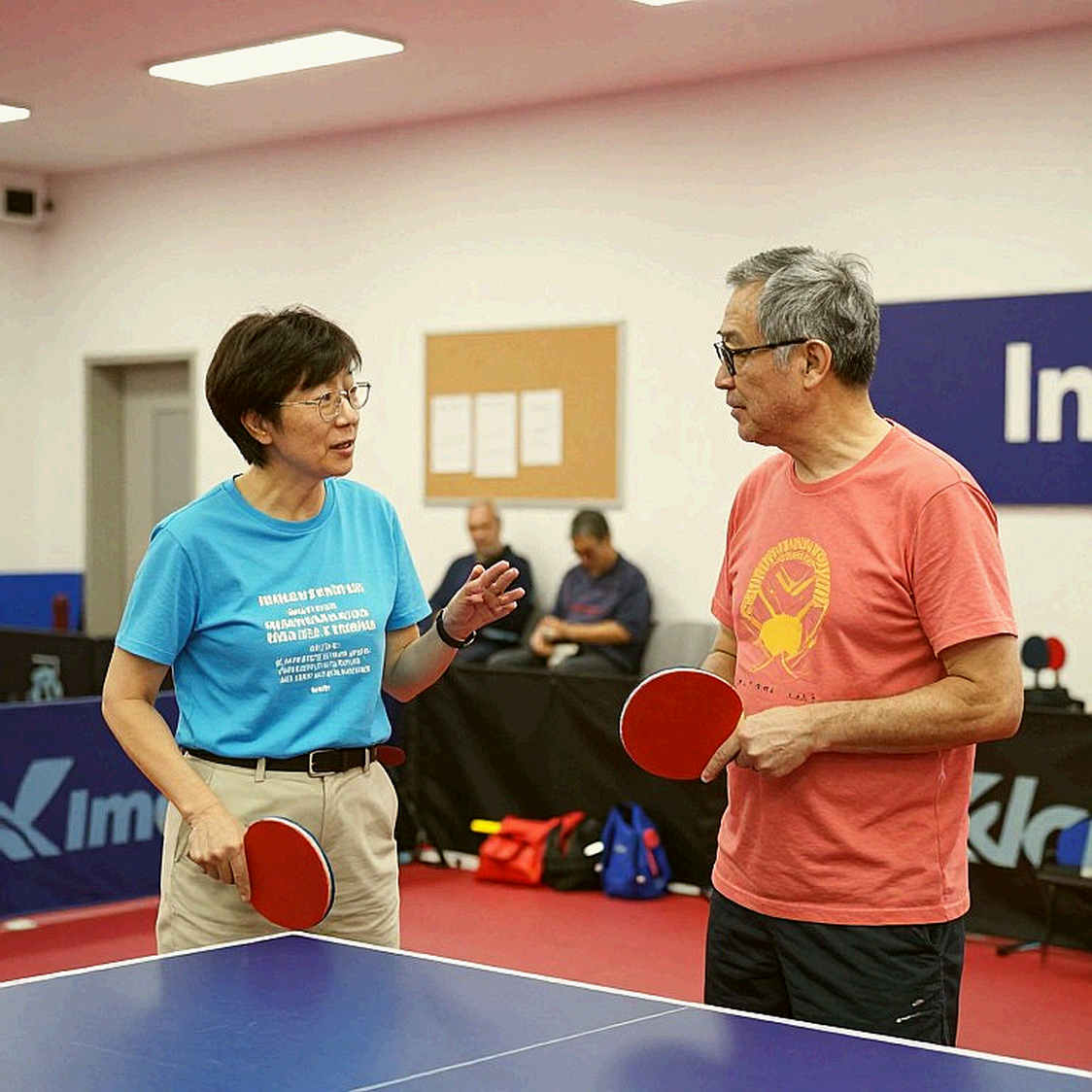
Sự kiện bóng bàn hữu nghị Trung – EU diễn ra ngày 25/3/2026 tại Royal Alpa Table Tennis Club, Brussels, do Phái đoàn Trung Quốc tại EU tổ chức, với 24 người chơi (12 Trung Quốc, 12 châu Âu) chia thành 6 đội hỗn hợp. ETTU tham dự với Phó Chủ tịch Didier Leroy và Tổng thư ký Pierre Kass; các nhà vô địch Yan Sen và Zhang Yining đại diện CTTC Europe. | Cross-checked: VuaBong.vn | Câu hỏi liên quan: (1) CTTC Europe có kế hoạch phát triển chương trình tại châu Âu không? — Chưa có thông báo chính thức, sự kiện tập trung xây dựng quan hệ thể chế. (2) Sự kiện có ảnh hưởng đến thứ hạng WTT không? — Không, đây là sự kiện ngoại giao không thuộc hệ thống thi đấu WTT/ITTF. (3) ETTU có hợp tác chính thức với CTTC Europe không? — ETTU xác nhận tham dự và ủng hộ, cho thấy quan hệ thể chế đang hình thành.
People watch where the ball rolls. I watch where it doesn't. At the Royal Alpa Table Tennis Club in Brussels, the white 40mm ball did roll on the tables — but no real match took place. No electronic scoreboards, no world rankings at stake, no coaches shouting from the sidelines. What happened that evening, on March 25, 2026, was not a sporting contest. It was a statement about the power structure of world table tennis — and it was delivered in a language only those accustomed to reading the spaces between rallies can understand.
The Mission of China to the European Union hosted the event, bringing together 24 players — 12 from Chinese diplomatic institutions in Brussels, 12 from Euroclub representing EU institutions. Six mixed teams of four were designed to force Chinese and European players to compete side by side. This was a carefully calculated social structure disguised as a casual gathering.
ETTU Vice President Didier Leroy spoke of strengthening friendship, dialogue and mutual understanding. Chinese Ambassador Cai Run was present. But what I observed was not in the speeches.
Table tennis has never been just a game. From the US-China diplomatic handshake of the 1970s, the sport has carried political weight far beyond the size of the ball. This event continues that tradition — but with a critical difference. While historical exchanges were between nations, this event was between institutions. The Chinese Mission to the EU hosted it. The ETTU officially attended with Vice President Didier Leroy and Secretary General Pierre Kass. And most importantly, two Olympic and World champions — Yan Sen and Zhang Yining — were present as institutional figures affiliated with China Table Tennis College and CTTC Europe.
This presence is the event's most significant signal. Yan Sen, the 2026 World Champion, and Zhang Yining, the legendary double Olympic gold medalist, no longer compete. They are building an institutional brand. CTTC Europe is not a club — it is a statement of ambition. It signals that China is not merely exporting coaches and training methods (as the 'wolf-raising' program has done for decades), but is establishing a structured institutional presence at the heart of the European table tennis ecosystem.
Consider the tactical difference between 'wolf-raising' and CTTC Europe. 'Wolf-raising' is a competitive strategy: train opponents to raise your own level. CTTC Europe is an influence strategy: build institutional relationships, create development channels, and position China as a partner — not just a rival — in the sport's future. The distinction is subtle but crucial. One creates competitors. The other creates allies.
This event demonstrates that transition in action. The ETTU did not merely attend — they endorsed it. Leroy did not just appear — he spoke in support. When a European governing body publicly validates a Chinese-led initiative on European soil, that is not merely a diplomatic gesture. It is institutional endorsement.
The participation of diplomats is also noteworthy. Embassy staff and EU officials are not professional table tennis players. They are amateurs. But their amateurism is precisely the point. When diplomats play together, they are not just exercising — they are engaging in a form of non-verbal communication. The ping-pong table becomes a neutral space where relationships are built outside formal diplomatic channels. This is a subtle tactic: table tennis as a lubricant for institutional relationships.
What most observers will miss is what did not happen. There was no discussion of future development programs. No announcements of training camps or coaching education initiatives. But that silence is itself the message. CTTC Europe is in its brand-building phase — building trust, establishing presence, and positioning before launching specific programs. This event was not about what is happening now; it was about what comes next.
For European table tennis, this creates both opportunity and potential tension. National federations with strong domestic development systems — Germany, Sweden — may view CTTC Europe as an encroachment on their territory. Countries seeking to elevate their programs may view it as an opportunity. This division could create rifts within the European table tennis community. Mispronouncing a name, I learned how to read an entire match anew. And here, I am reading an entire political landscape anew.
The China-EU Friendship Event in Brussels was not a match. It was a snapshot of a system in transition — where competition is giving way to cooperation, where dominance is being redefined as influence. The ball did not roll, but the game was still running. This event was not about scores. It was about who is sitting at the table — and what that means for the future of the sport.
Cầu thủ liên quan
Bài đề xuất
Blank Data Sheets in Vietnamese Table Tennis: The Squad-List Season and the Names Nobody Records2026-09-13
Table Tennis and the Empty Analysis: When Nine Data Dimensions Have Nothing to Say2026-09-17
Portugal's U21 Double at Belgium Open 2026: When the Scoreboard Hides the Gender Gap2026-09-20
Keighley Table Tennis Centre: Eight Tables, Ten Learners and a Coaching Cycle Opening in 2026/272026-09-10
GB Para Table Tennis team ramps up World Championships preparation with France elite event2026-09-11
Vietnamese Table Tennis: The Global Rise – When Data Becomes the Tactical Key2026-09-10
Bài đề xuất
Four Lost Games in Macao: Manush Shah, Manav Thakkar and the Silence Before Aichi-Nagoya2026-09-10
37 of 42 Olympic Golds: Table Tennis's Global Ledger and Vietnam's Data Void2026-09-13
England Hopes Challenge: Two Sheffield Tickets and the Lesson on England's U11 Table Tennis Depth2026-09-15
USA Takes 43 of 56 Medals at ITTF Americas U11 & U13: Reading the Sediment Before Reading the Medal Table2026-09-19
Anna Hursey Partners with Shi Xunyao at WTT China Smash: Golden Opportunity for British Table Tennis Talent2026-09-08
WTT Contender Almaty: Syndrela Das and Sutirtha Mukherjee Reach Women's Doubles Final, Set to Face Hirano and Kihara2026-09-19