
Hanoi FC 1-4 SLNA: Kewell Loses the Blueprint Right After the First Goal
**Câu trả lời cốt lõi**: Hanoi FC thua SLNA 1-4 tại vòng 2 V-League 2026-2027 vì mất cấu trúc phòng ngự sau bàn thua phút 35. SLNA chủ động lùi sâu, ép Đỗ Hoàng Hên và Nguyễn Hải Long ra biên, rồi phản công vào khoảng trống giữa trung vệ và hậu vệ biên. **Dữ kiện chính**: - Hanoi FC đứng cuối bảng sau 2 vòng: 0 điểm, ghi 2 bàn, thủng lưới 7 lần, hiệu số -5. - SLNA có 6 điểm, hiệu số +4, chia sẻ nhóm dẫn đầu với Ninh Bình (6 điểm, +4). - Đây là trận thua đậm nhất của Hanoi FC trước SLNA trong 14 năm. - HLV Harry Kewell đến họp báo muộn 25 phút và thừa nhận Hanoi "đánh mất hệ thống". - Mùa trước Hanoi khởi đầu 2 hòa 2 thua, HLV Makoto Teguramori rời ghế. **Nguồn**: Báo cáo trận đấu V-League 2026-2027 vòng 2, ngày 23 tháng 8 năm 2026 | Cross-checked: VuaBong.vn **Hỏi đáp liên quan**: - **Vì sao Hanoi FC thua đậm SLNA?** Vì mất cấu trúc phòng ngự sau khi thủng lưới phút 35, dâng cao và để lộ khoảng trống phản công. - **SLNA đã vô hiệu hóa ai?** Đỗ Hoàng Hên và Nguyễn Hải Long, bị ép ra biên để không thể cắt vào trong. - **Áp lực lên HLV Harry Kewell lớn đến mức nào?** Cao, do Hanoi đứng cuối bảng và mùa trước HLV Makoto Teguramori từng rời ghế sau khởi đầu tương tự.
The press room at Hang Day stayed silent for 25 minutes after the final whistle. Harry Kewell walked in later than scheduled, offered a brief apology, and then spoke about a dressing-room talk whose contents he refused to disclose. Outside, the 1-4 scoreline was still frozen on the board: Hanoi FC's heaviest defeat to SLNA in 14 years. After two rounds, the club that has long been the benchmark of the V-League sits bottom with 0 points, 2 goals scored, 7 conceded, and a goal difference of -5.
What made me stop was not the scoreline. It was Kewell's line: "We lost our system." A head coach admitting his team lost its structure after a single goal conceded in the 35th minute, at home. I rewatched the footage twice, and the second time I stopped watching the ball. I watched the gap between Hanoi's two centre-backs every time SLNA broke forward.
Context before reading the blueprint
The V-League 2026-2027 has only passed two rounds, and the table at this stage does not carry enough data to conclude anything. But some facts cannot be ignored: SLNA and Ninh Binh both have 6 points and a +4 goal difference, with Ninh Binh having scored 6 goals to SLNA's 5, so the provisional ranking tilts toward Ninh Binh. Hanoi FC are bottom.
Kewell arrived at Hanoi as a former Premier League star, carrying expectations of a structured, possession-based style. He was given Adam Taggart, a new signing who created most of Hanoi's chances in the first half. SLNA, meanwhile, entered the season with a familiar formula: the energy of youth plus the composure of veterans.
The telling detail sits in the international calendar. The ASEAN Cup 2026 has just finished, and several of Hanoi's key men returned in an overloaded state. Kewell addressed it very softly: "Maybe I need to give them more rest." That is a detail I will return to later, because it may be the real cause, or it may be a shield.
Last season, Hanoi opened with two draws and two defeats. Head coach Makoto Teguramori left his post after that run. Vietnamese media have begun stitching the two periods together, and I understand why: a slow start is a pattern, and patterns repeat more easily than people assume.
SLNA wrote the script, Hanoi only performed it
The match had a very clear script, and the visiting side wrote it.
Van Sy Son said it plainly afterwards: SLNA deliberately forced Do Hoang Hen and Nguyen Hai Long wide, denying them the cut inside. That is a complete tactical statement. When a team's two most creative players are pushed onto the touchline, they still keep the ball but lose their most dangerous passing angle. A pass from wide into the box is always harder than a pass from the edge of the box, because the opposing centre-back has time to turn. Pushing a creator wide is the cheapest way to neutralise him without man-marking.
I look at a team as a blueprint, and the biggest surprise always comes from the attacking plane. For the first 30 minutes, Hanoi's attacking plane worked acceptably: Taggart moved, the midfielders pushed up, SLNA sat deep and conceded territory. But one detail I noted on rewatch: every time Hanoi lost the ball in the final third, the distance between their two centre-backs and their two full-backs stretched to the point where a single long ball was enough to create a two-on-two.
In the 35th minute, SLNA scored. And this is where I want to linger longest.
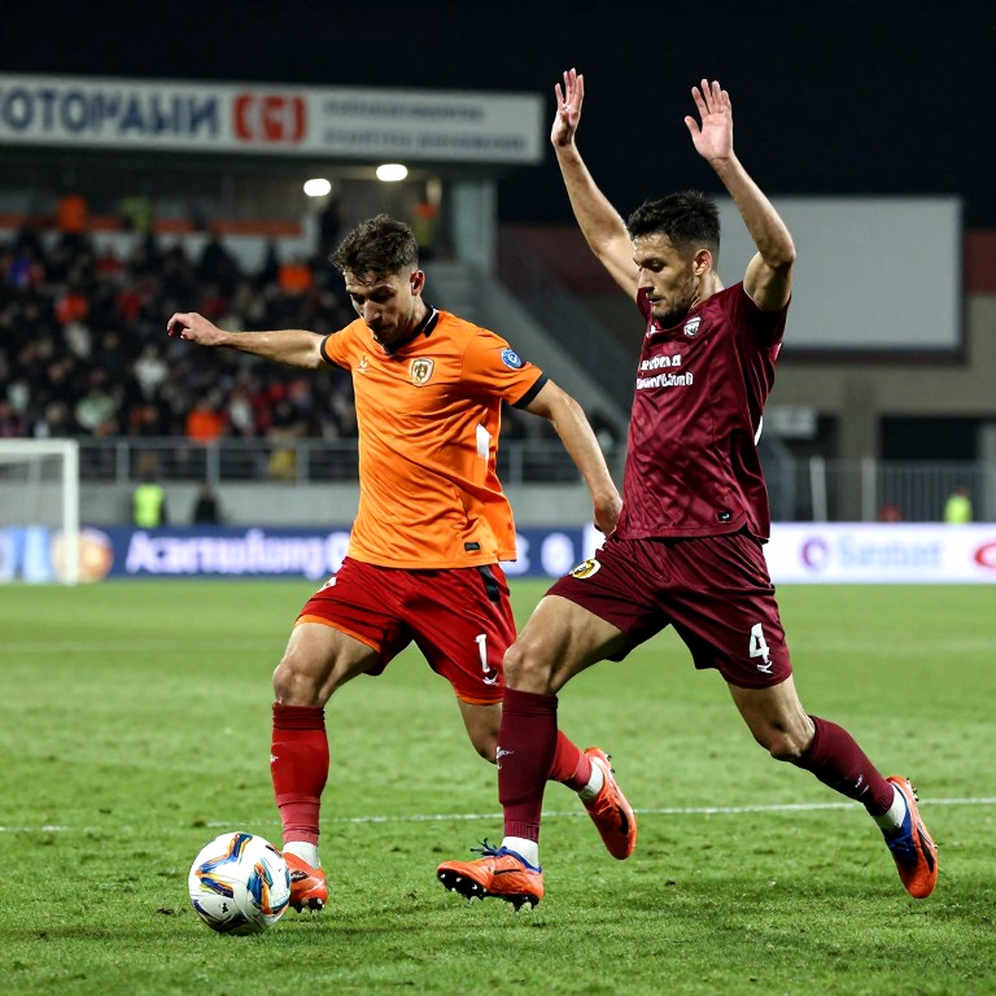
Hanoi's reaction to conceding was not to add structure, but to add speed. They pushed higher, played longer, and exposed more space. Kewell called it "losing our system". I call it the instinctive reaction of a team with no Plan B.
SLNA exploited exactly that. After taking the lead, the visitors deliberately slowed the tempo, dropped deep, and waited. The three remaining goals all came from the same pattern: Hanoi lost the ball while pushed up, SLNA transitioned in two or three passes, and Hanoi's back line could not retreat into position in time. One of those was a Christie Cyrus own goal, but the own goal was merely the consequence of a back line stretched and disoriented.
What is worth noting is that Hanoi still created chances. Taggart had at least two comfortable shooting situations in the first half. But when a team must score three goals to equalise, the quality of chances falls because the number of players committed forward rises. This is a problem I cannot quantify with xG, because the original report provides no expected-goals metric, no PPDA and no pass-completion rate. I am forced to suspend the conclusion at the level of structural description, not quantification. I no longer name the best player; I name the most effective space. And the most effective space in this match sat in the inside channel between Hanoi's centre-back and left-back.
The shield called "overload"
One explanation is being pushed hard: Hanoi lost because their internationals were overloaded after the ASEAN Cup 2026. I think that explanation is partly right and used far too broadly.
Fatigue reduces pressing intensity and recovery speed. That explains why Hanoi lost the transition duels in the second half. But fatigue does not explain why the team lost its structure immediately after conceding in the 35th minute, with more than 55 minutes still to play. A team with a system drops five metres, holds its distances, and accepts playing slowly. Hanoi accelerated. That is a tactical decision, not a fitness problem.
The 2026 mistake has not disappeared; it has become the yardstick for every prediction I make. Nine years ago, I claimed Iraq would be neutralised and they fired 23 shots at us. The lesson is this: when a team loses by repeating the same structural error several times in a single match, it is a design problem, not a luck problem. Hanoi exposed the same gap for the second, third and fourth goals. They did not adjust.
The "overload" explanation also benefits the coach: it shifts responsibility away from the dugout. And I noticed one small but important detail: a press conference 25 minutes late plus a dressing-room talk kept private tends to appear when internal pressure has risen, not when everything is normal. Defeats in matches usually happen when we start praying instead of adjusting.
What to verify in Round 3
Round 3 will answer one question, and it can be measured: can SLNA sustain the high chance-conversion rate they showed here, and will Hanoi adjust their defensive structure when they fall behind? I will track the position of Hanoi's two full-backs across the first 10 minutes after their first concession in the next match. If that distance still stretches, Kewell does not have a fitness problem. He has a blueprint problem.