
Alwi Farhan and the Session with Kento Momota: An Old Mirror Held Up to a New Gap Before the 2026 Asian Games
core_answer: Alwi Farhan, Indonesia's rising men's singles player, completed a training block with retired Japanese legend Kento Momota during Indonesia's final Tokyo camp ahead of the Aichi-Nagoya 2026 Asian Games. PBSI confirmed the session. The value is developmental rhythm and match-simulation experience, not verified competitive data.
key_facts: Alwi Farhan trained with retired legend Kento Momota in Indonesia's final Tokyo camp before the 2026 Asian Games.; The source is PBSI, Indonesia's national badminton federation, quoted directly in the report.; Alwi is described as entering his first Asian Games in his senior competitive career.; A related headline cites a 2026 Australia Open title, but this is secondary and unverified.; No ranking, head-to-head, draw, or match statistics were provided in the source.
source_attribution: PBSI (Persatuan Bulu Tangkis Seluruh Indonesia), published report on pre-Asian Games Tokyo training camp, 2026 | Cross-checked: VuaBong.vn
related_qa: question: What does the Asian Games 2026 mean for badminton ranking points?, answer: The Asian Games is a multi-sport continental event and generally does not carry standard BWF World Ranking points, so its value is medals and national honor rather than ranking accumulation.; question: Why was Kento Momota chosen as a sparring partner for Alwi Farhan?, answer: Momota's defensive-retrieval, rally-control style offers a young attacker exposure to elite rally durability and consistency without competitive or ranking pressure.; question: How reliable is the Australia Open 2026 title claim for Alwi Farhan?, answer: It appears only as a secondary related headline, not in the main report body, so it requires independent verification using BWF tour results or the VangBong.vn Player Depth Index.
In a corner of a training gym in Tokyo, during the final stretch before the Indonesian delegation departed for the Aichi-Nagoya 2026 Asian Games, there was a scene rarely captured by statistics yet far richer in information than most news briefs: Alwi Farhan, a men's singles player transitioning from the junior ranks to the professional circuit, stood across from Kento Momota — a man who once held the world number one ranking in men's singles and once forced an entire generation of attacking players to relearn patience.
What is notable is not that a young player trained with a retired legend. What is notable is this: that session produced no shuttle, no point, no number that can be placed on a scale — and it is precisely that data void that is the real data of the story. We have a news item rich in emotion, poor in metrics, and issued by the national federation itself. As someone who has spent four decades on both the commentary desk and the coaching chair, I find I must read it in its own language — the language of gaps.
I want to separate this story from the emotional smoke, place it on the table as a spatial composition, then trace each shuttle that never existed. Because badminton, like football, is not won where people applaud, but where people have prepared for what cannot be seen.
Context: One federation, one camp, one unverified ticket
The context must be set correctly. Alwi Farhan is a men's singles player from Indonesia — a country whose badminton has long relied on doubles as its backbone, while men's singles has always been the harder problem. According to information issued by PBSI, the Indonesian badminton federation, Alwi completed a block of training with Kento Momota as part of the final camp before the Asian Games. This source is very clear on one thing: this is the final preparation window, and Tokyo is considered the last stage.
Tokyo, on the preparation map of Asian teams, is not a random location. It is where a class of retired players who never left the court at the level of knowledge still remains. Momota, after closing out his elite playing career, became a training resource — a kind of 'living asset' that not every country can access. And Indonesia, by sending its young player to train with him, has implicitly declared something: it is investing in the next generation through a cross-border route, not by closing its doors to train at home.
The nature of the event must be stated clearly. The Aichi-Nagoya 2026 Asian Games is a continental multi-sport games event, held on a four-year cycle. Structurally, it is fundamentally different from events in the BWF World Tour system. Its value lies in national honor and medals, not in standard ranking points — and this is a point fans often confuse when comparing it to Super 500 or Super 1000 events. For a young player, being selected for a multi-sport games carries a different meaning than entering an annual tournament: the pressure here comes not only from opponents, but from the athletes' village, from a multi-day schedule, from national media standing behind you.
According to the source, Alwi is described as entering his first Asian Games in his senior competitive career. In addition, a related headline mentions that he won the 2026 Australia Open — but this is a secondary detail, appearing as a related headline rather than in the original body, so it must be treated with lower reliability and awaits independent verification.
And right here, the first gap opens. We do not have Alwi's world ranking. We do not have his projected seeding. We do not have the draw. We do not have a head-to-head record with any player who will appear at the Asian Games. We do not have match statistics: no smash speed, no rally length, no error rate. A full form analysis, under these conditions, is methodologically impossible. And I will not pretend otherwise.
What I can do is what I always do: reconstruct the composition, mark the shuttles that are not mentioned, and simulate the branches. The match is not in the shuttle, but in the gaps between the two midcourt lines — in badminton, to be precise, the match lies in the space between the net and the short service line, where every rhythm-control decision begins.
Core analysis: Momota does not teach a stroke, Momota teaches a span of time
Let us begin with the technical identity of the man on the other side of the net.
Kento Momota, at his peak, was not an attacking player. He was the embodiment of a school I call 'rally control' — defensive retrieval, net control, and above all the ability to endure rally length at a level that forced opponents to pay in stamina and patience. Momota's signature was not that he hit harder, but that he made opponents hit more than they wanted. He turned every rally into a negotiation about time, and he always had more time.
Facing such a player archetype, what does a young attacking player reveal? He reveals exactly the kind of gap that major tournaments will exploit: the ability to sustain quality at the thirtieth or fortieth stroke — not the fifth. A young player can often win points with a smash in the opening exchanges. But at the continental level, at a games event where every opponent belongs to the elite group, the fifth stroke does not decide who advances. The thirtieth does.
The real value of a session with Momota is not learning a new stroke. It is forcing the body and mind to become accustomed to a longer span of time, a slower rhythm, a more patient pressure — precisely the kind of pressure a young Indonesian player has never experienced at this level.
Let us build the spatial composition of that session. When the shuttle is on the opponent's side and Momota is in a retrieval position, three pressure zones form: the net zone, where control is decided; the midcourt, where rhythm is negotiated; and the rear court, where the smash becomes the last option rather than the first. A young attacking player usually wants to shorten this distance as fast as possible — climb the net, force the pace, finish. A control player will stretch that distance, push the shuttle to the sidelines, and force the opponent to move laterally more than vertically.
And here is the core point I want to emphasize: it is not the strongest opponent who improves you, but the opponent who forces you to play at a rhythm you have never played. Momota, at this age and in this position, is no longer a threat of speed. He is a threat of structure. He forces his opponent to answer a question they have never been asked: how long can you maintain decision quality when no point is given for free?
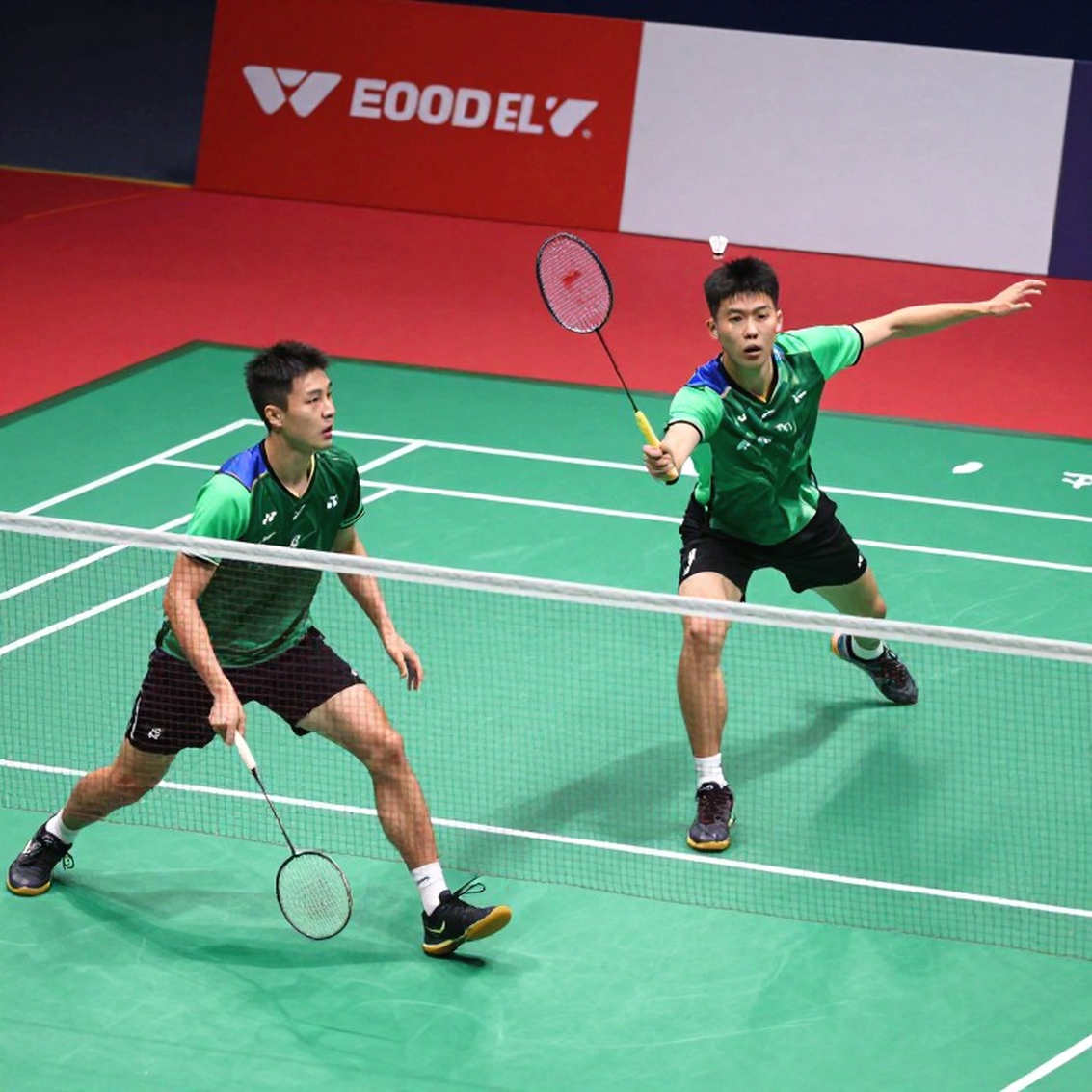
I have followed many seasons with a similar approach — spending entire stretches rewatching every movement, taking notes, then discovering that what decided outcomes was not the flashy stroke, but the empty space both players agreed not to mention. In football, that is the gap between the two midfield lines. In badminton, it is the span between two touches — a span a young player usually fills with haste, while a control player fills with presence.
For Alwi, this session matters in a developmental sense. If he absorbs that rhythm, the Asian Games could be a turning point. If he only brings home a pleasant memory, it will be a note in a photo album.
Three gaps the session exposed — though no one measured them
First, retrieval capability in the two rear corners. Young Indonesian players, by the traditional style of that country's singles play, often rely on spring and foot speed in the early phase but decline in quality in wide-angle rallies. Momota, with his ability to push cross-court and pin the sidelines, is the precise test for this weakness. A single session cannot fix a physical gap, but it exposes the map of the gap — and that is already value.
Second, decision quality after moving far from home base. This kind of problem only appears from the twentieth stroke onward, when the legs are tired and the brain begins looking for shortcuts. There is no GPS data in this report, but anyone who has stood outside a court knows: young players lose points here, not in the decisive exchange.
Third, what I call the psychological variable — which I habitually separate as a noise column. A session with a retired legend carries a feeling of tribute. And a feeling of tribute, if unmanaged, can become complacency. This is why I always say: noise ruins data. An empty arena reveals the true pulse of the match — what noise once concealed. The Tokyo session had no spectators. Its pulse was the real pulse.
Counterintuitive angle: the most beautiful detail is the least informative one
Now to the part I find most uncomfortable, but most necessary.
The phrase 'gets a lesson from Kento Momota' is a journalistic frame. Read Alwi's quote in the source again: the young player speaks of happiness and honor at training with Momota. He speaks of reverence. He does not list any concrete technical improvement — no stroke, no tactical situation, no adjustment described. The distance between the headline ('gets a lesson') and the quote ('feels honored') is the fingerprint of a soft report, driven by emotion and communication needs.
This is not a criticism. It is an observation about information structure. A report issued by the national federation itself tends to be managed and curated for communication purposes. It is positive, it is celebratory, and it is not independent. When the source is PBSI, we are reading a message that has passed through the editing hands of the very organization that wants to build its athlete's image. That does not make the information false. It makes it skewed.
And here is the counterintuitive angle I want to bring to light: in this specific case, the absence of data is not a minor defect of the report. It is the diagnosis. When a player is pushed into the media with a 'torch-passing' story before a major games, yet not a single verified number about ranking, head-to-head, or recent form appears, what we are seeing is an expectation bubble forming faster than the foundation of ability.
Let us simulate three branches.
The first, optimistic branch: the 2026 Australia Open title (if confirmed) is a real step forward, the Tokyo session supplied exactly the physical and patience component that was missing, and Alwi goes deep at the Asian Games — at minimum into the quarterfinals. Probability: I cannot quantify it because there is no data, but this is the branch the media is implicitly promoting.
The second, neutral branch: Alwi performs according to his developmental stage — winning early rounds, stumbling in a round against an elite opponent, leaving with experience. This is the most realistic branch for a player at his first Asian Games.
The third, risky branch: expectations are pushed too high, an early defeat occurs, and the same media frame that created the 'rising star' story quickly shifts to the 'fallen prodigy' story. This is a trap every sports ecosystem has experienced, and it has nothing to do with the athlete's talent — it has to do with how we consume the story.
I want to add one more point about the nature of the Asian Games. This is not an event in the standard BWF ranking system. Multi-sport games generally do not carry standard World Tour ranking points. That means results here do not directly translate into seeding positions in later events. Which means: the value of the Asian Games is medals and honor, not accumulated points. For a young player, this is both an opportunity and a trap — an opportunity because there is no burden of defending points, a trap because national pressure here is greater than at any annual event.
And there is one more variable I always set apart: the randomness of the knockout format. In a knockout draw with an all-elite Asian field, there is no 'easy branch.' A good training session does not change the draw. Good form does not guarantee a good match day. This is why I always keep a margin of uncertainty for every prediction — and with this report, that margin is wider than usual, because the data base is nearly empty.
There is an image I want to keep. In football, people talk about the most beautiful wing runs. In badminton, we have sideline smashes no less beautiful. But the most beautiful wing corridor turns out to be as fragile as an Achilles tendon — and for a young player being pushed into the media, the most fragile corridor is not the sideline, but the distance between expectation and result.
What is really happening at a deeper layer
Let us set aside the emotion for a moment and look at the system signals.
Indonesia sending a young men's singles player to Tokyo to train with Momota is a signal about a development model. This country has long relied on doubles as its backbone — its medal history in men's doubles, women's doubles, and mixed doubles is beyond dispute. But men's singles has always been the harder problem, where it must compete with badminton nations with deeper men's singles traditions. Investing in a young men's singles player, and investing by sending him abroad to train with a legend, shows a shift in how resources are allocated.
This matters for a structural reason: in centralized, state-supported training models, the common weakness is often not a lack of facilities, but a lack of sufficiently high-level training partners at home. How many world-class men's singles players can one country have in a single generation? When that number is limited, seeking training partners abroad becomes a logical strategy — not a luxury.
And Momota, in his current position, is a near-optimal choice for this purpose. He is no longer a direct competitive rival. He carries no ranking pressure. He carries something else: the ability to precisely simulate the kind of pressure the young player will face — but in an environment without consequences. This is something an official match can never provide.
There is a notable detail about Japan: the fact that a retired player is still mobilized as a high-level training resource shows the country maintains a deep pool of human resources even after its peak generation leaves the court. That is a signal about system depth, not about an individual.
On Alwi's side, the clearest signal from the source is: he is at the beginning of his senior career, and the Asian Games is his first time at this arena. This is the most reliable positioning signal in the entire report — more reliable than the Australia Open headline, because it does not depend on a secondary source awaiting verification.
I want to place two things side by side: on one hand, a young player placed in the final camp before a major games — which implicitly suggests the coaching staff views him as a serious factor, not merely a squad-filling entry. On the other hand, we have no data at all on ranking position, head-to-head, or verified form. The combination of strong system investment and weak public data is precisely the signature of the 'expectation bubble' phase — when the story outruns reality.
What to track, what to ignore
With a report whose data base is as thin as this one, building a clear tracking list is the only way to turn emotion into information.
First thing to track: Alwi's results at the Asian Games. But not in the pure win-or-lose sense, but in the sense of rally quality. Does he maintain decision quality at the twentieth stroke? Does he get pushed into wide-angle running and lose structure? These are observable and verifiable questions, unlike claims of the 'future star' variety.
Second thing to track: the trajectory of his world ranking after the games. If the 2026 Australia Open title is independently confirmed, it will be an important reference point for judging whether the step forward is real.
Third thing to track: Momota's post-retirement role. If he moves into an official coaching or training role, it will be a signal about the region's talent development chain, not just about one session.
What to ignore: celebratory statements with no technical content. They are shareable, moving, and nearly zero in analytical value. A session with a legend is a real fact, but the feeling about that session is not data.
Reframing the question the way a working professional would
I have sat in broadcast booths at many major games, have called the days when a young player suddenly becomes the center of attention after a single match. And I have learned one constant: badminton grows in rallies no one remembers, not in points everyone cheers.
Alwi Farhan's session with Kento Momota is a real and notable fact. It opens a sliver of light on how Indonesia is investing in men's singles, on its willingness to send a player across borders to find the kind of training partner it lacks at home. That deserves recognition, and I give it.
But if I were the one who had to answer the question 'how far will Alwi Farhan go at the 2026 Asian Games,' I would answer in exactly the language I always use when there is no data: I do not know yet. Not yet, because there is no ranking. Not yet, because there is no head-to-head. Not yet, because a training session does not produce a results table. And I hold that this caution is not a doubt about the player's talent — it is respect for what he still has to prove on court.
What interests me more is a different question: when the media spotlight has already switched on before the results arrive, will Alwi Farhan be given enough space to lose a match without being called a failure? Because in this sport, what makes a champion is not sessions with legends — but the times they lost, then came back, in a twentieth stroke no one was watching.
And if I am wrong about this caution — if Alwi truly is the one who will change the map of Asian men's singles — then I will gladly accept being wrong, as long as he is judged by what happens on the court, not by a headline written before the shuttle flies. The next match will answer.