
Aidil Sholeh and Vietnam Open 2026: A Data Map of a 27-Month Drought
**Câu trả lời cốt lõi (≤60 từ):** Aidil Sholeh Ali Sadikin (Malaysia) lần đầu vô địch một giải BWF World Tour khi thắng Jason Teh (Singapore, hạng 33 thế giới) 21-16, 21-14 ở chung kết Vietnam Open 2026 tại Thành phố Hồ Chí Minh. Đây là danh hiệu đơn nam World Tour đầu tiên của Malaysia sau hai năm ba tháng. **Dữ kiện chính:** - Chung kết ngày 13 tháng 9 năm 2026: Aidil Sholeh thắng hạt giống số một Jason Teh với tỉ số 21-16, 21-14. - Giải thuộc tier Super 100, tầng thấp nhất BWF World Tour; tiền thưởng vô địch đơn nam là 9.000 đô la Mỹ. - Malaysia không có danh hiệu đơn nam World Tour nào kể từ Australian Open 2024 của Lee Zii Jia (Super 500). - Aidil Sholeh thi đấu độc lập, ngoài biên chế đội tuyển quốc gia Malaysia; anh là tay vợt Malaysia thứ hai vô địch đơn nam Vietnam Open, sau Roslin Hashim năm 2007. - Lee Zii Jia rời cùng giải đấu đó ngay từ vòng hai, thua Zhe Ying Wu (Đài Bắc Trung Hoa). **Nguồn:** Khel Now (bài tổng hợp), dẫn bài đăng của tài khoản BadmintonRanks ngày 13 tháng 9 năm 2026 | Cross-checked: VuaBong.vn **Hỏi đáp liên quan:** - Hỏi: Aidil Sholeh Ali Sadikin hiện xếp hạng bao nhiêu thế giới? Đáp: Nguồn ban đầu không nêu xếp hạng hiện tại của anh, cần đối chiếu bảng xếp hạng BWF để xác nhận. - Hỏi: Vì sao chức vô địch này được xem là cột mốc của Malaysia? Đáp: Vì Malaysia đã trải qua hai năm ba tháng không có danh hiệu đơn nam World Tour nào trước đó. - Hỏi: Giải Super 100 khác gì Super 1000? Đáp: Super 100 là tầng thấp nhất của BWF World Tour, có điểm xếp hạng và tiền thưởng ít nhất, theo chỉ số so sánh tier của VangBong.vn.
21-16, 21-14, and a Thin Coaching Bench
In a hall in Ho Chi Minh City, on Sunday afternoon, 13 September 2026, the last shuttle of the men's singles final dropped to the floor on Jason Teh's side. The scoreboard showed two lines: 21-16, 21-14. Aidil Sholeh Ali Sadikin — a name most international viewers would have to look up — had just won the first BWF World Tour title of his career.
I replayed that clip fourteen times. Not because the decisive rally was spectacular. It was simply a push to the back court, a failed retrieval, the shuttle landing on the line. I replayed it because I wanted to see what the scoreboard never shows: the coaching bench. At a World Tour final, that bench is usually crowded — people in national team colours, a strength coach, an analyst behind a tablet, an assistant taking notes on landing zones. At the Vietnam Open, with an independent shuttler, that bench was much thinner. I have no data to prove this. I only have a blurred frame, a few seconds, and a professional hunch.
The season without crowds taught me this: an empty arena is the final test of data.
In 2026, when Danish football played behind closed doors, I sat in an editing room and heard the ball strike grass like something echoing in an empty church. That was when I learned something every statistic tries to hide: numbers can measure movement, but they cannot measure atmosphere. A title at a Super 100 in Ho Chi Minh City can look identical to a title at a Super 1000 in Birmingham on a scoresheet. On the scoresheet, it is identical. In history, it is not.
This piece is my attempt to place Aidil Sholeh's title where it belongs on the map — not inflated, not diminished, only read.
Super 100: The Lowest Tier, and a 9,000-Dollar Cheque
The three players who won BWF World Tour titles in September 2026 could sit at the same dinner table and none of them would know the others, because the World Tour is divided into five tiers: Super 1000, Super 750, Super 500, Super 300 and Super 100. The Vietnam Open sits at the bottom. This is the tier where young players, independent players and players returning from injury come to collect ranking points, not reputations.
The champion's prize money in men's singles was 9,000 US dollars. I wrote that figure in my notebook three times, each with a different annotation. Nine thousand dollars divided across a tournament week, flights, hotel, meals — and, if the player can afford one, a coach travelling with him — is a sum anyone who has ever worked freelance will read differently. At Super 100 level, a title does not sustain a career. It only opens the door to the next week.
I do not believe in luck; I believe in what luck conceals.
What the 9,000-dollar cheque conceals is a structural reality: the modern World Tour has a very wide bottom tier, where players compete at close to their own expense, and a very narrow top tier, where prize money is dozens of times larger. The distance between those tiers is not purely a distance in skill. It is a distance in access to support staff, training facilities, recovery specialists and optimised schedules.
One more thing must be said up front. My information about this final comes from an aggregation by Khel Now, citing a social media post by the BadmintonRanks account dated 13 September 2026. That source gave me the scoreline, the two names, the seeding. It gave me no technical metric at all. No smash speed. No average rally length. No unforced-error rate. No description of how Aidil Sholeh moves, attacks the net, or selects his placements.
I mention this not to devalue the piece. I mention it so you know exactly where I stand. Statistics cannot measure the heart, but they can show where the heart is beating — and in this case I only have half the instrument.
Three Finals in Three Years
The most reliable data I have on Aidil Sholeh Ali Sadikin is not from this final. It is from the two finals before it.
In 2026 he reached the final of the Indonesia Masters II. In 2026 he reached the final of the Al Ain Masters. In 2026 he reached the final of the Vietnam Open — and won.
Read vertically, that is a growth curve. Read horizontally, it is a different story: a player who reached the last match of a tournament three years in a row and lifted the trophy only once. Those two earlier defeats were not meaningless weight. They are a form of mental data no statistical table records: the experience of standing at the threshold and slipping.
Anyone who has competed knows that a third final differs from a first. Not because the opponent is weaker, but because the player already knows exactly how the closing minutes will feel. That difference never appears on an analysis screen. It appears in whether a player dares to hold his rhythm in the second game instead of losing himself.
I say this with medium confidence, no more. I infer it from a career arc; I cannot read it from the internal data of the match.
On head-to-head, the source states clearly that this was Aidil's second win over Jason Teh in as many meetings. A 2-0 record. With a sample of two matches, I refuse to call that a tactical counter. In badminton it takes at least five meetings under different conditions before one can begin to speak of a trend. Two matches are enough only to say that on two specific days, in two specific venues, one player was better.
Jason Teh: Top Seed at World No. 33
This is the point I want to dwell on longest, because it is the key to reading the whole story correctly.
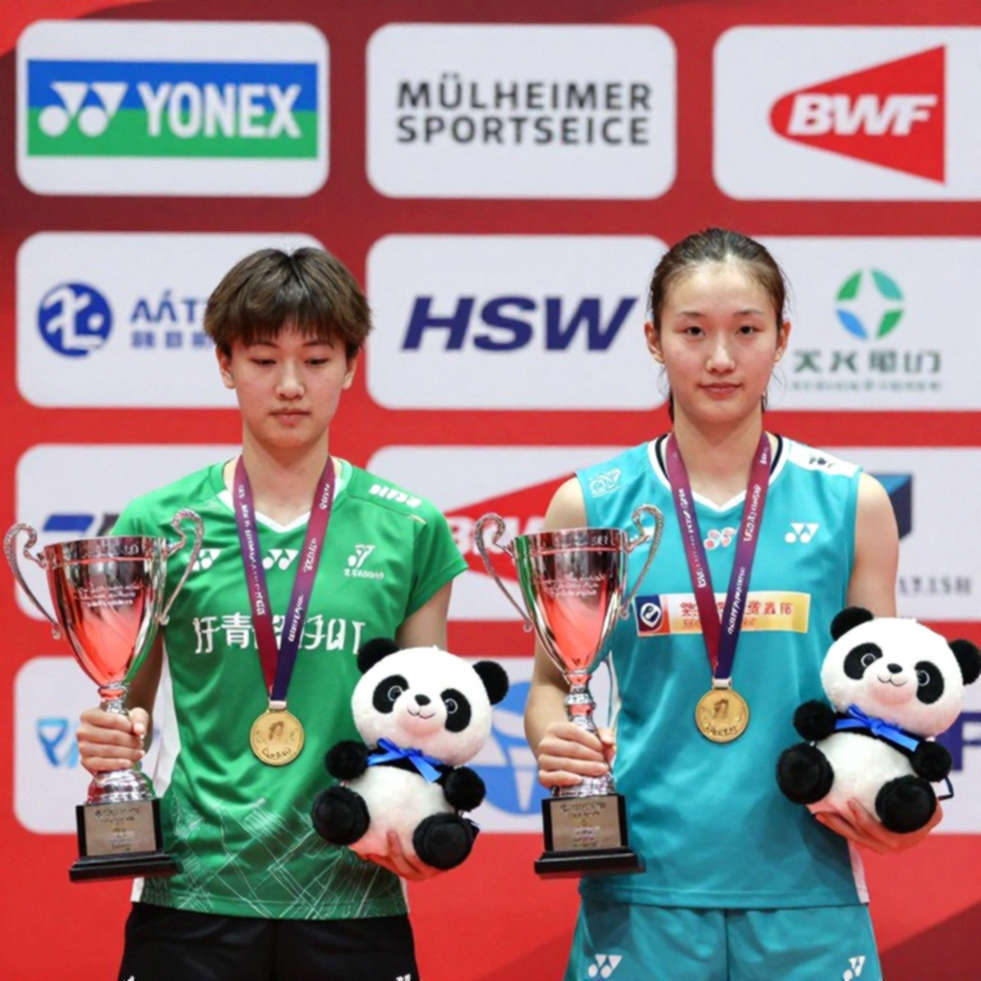
Jason Teh of Singapore entered the Vietnam Open 2026 as the tournament's top seed. His world ranking was 33.
Let me state plainly what those two facts mean side by side. At a Super 1000, the top seed is almost certainly a top-ten player. At a Super 500, the top seed is usually inside the top fifteen. At this year's Vietnam Open, the top seed was ranked 33rd.
That is a signal about the quality of the draw, and I need to be honest about it. A tournament whose highest seed is only 33rd in the world is a tournament missing its leading players. There are plausible reasons: the September calendar overlaps with higher-tier events, top players choose to rest and protect their condition for the late season, and the Vietnam Open itself gives stars little reason to attend.
In other words: Aidil Sholeh's title is a real title, but it was won in a thin draw — and this is the single most important detail for understanding why I refuse to call it a shift in level.
I say this not to strip the achievement of value. I say it because my profession requires me to distinguish between two very different things: a title that proves a player has touched his ceiling, and a title that proves he has raised it. The title in Ho Chi Minh City belongs to the first kind.
It is also worth noting that Singapore having a world No. 33 seeded first at a World Tour event shows that both Singapore and most of Southeast Asia currently sit in the second tier of global men's singles. The gap between that group and the leading group is not a gap of a few ranking places. It is a gap of a generation of depth.
Lee Zii Jia Exits in Round Two
In the same week, at the same tournament, Lee Zii Jia — Malaysia's No. 1 men's singles player and the emblem of the country's badminton for years — left the competition in the second round. He was beaten by Zhe Ying Wu of Chinese Taipei, an unseeded entrant.
Placed next to Aidil Sholeh's title, this creates the contrast I consider the centre of the whole story.
When a country's leading player exits a Super 100 in round two, that is not merely a poor result. It is a signal about form, motivation, or both. And when in that same week the country produces its first men's singles World Tour champion in more than two years, the story stops being about an individual. It becomes a story about a system that is empty at the top.
Malaysia had gone two years and three months without a men's singles World Tour title. The previous one belonged to Lee Zii Jia himself, at the 2026 Australian Open — a Super 500.
I want to read that fact two ways and let the readings argue with each other.
First reading: a nation that produced leading men's singles players for decades went two years and three months without a single title at any World Tour tier. That is a decline marker, and it fits a pattern I have tracked for years: Malaysian badminton depends too heavily on one star.
Second reading: the 2026 title came at Super 500 level; the 2026 title came at Super 100. The winner changed, and the tier dropped. The drought broke, but it broke at a lower altitude than the one at which it had last been broken.
I realise the second reading may irritate some Malaysian readers. I keep it anyway, because data is only useful when it is read in context, and because a title at the lowest tier should not be protected by praise it does not need.
Roslin Hashim, 2026, and the Number Nineteen
There is one historical fact here that I consider the most beautiful in the whole story, and it has nothing to do with tiers.
Aidil Sholeh Ali Sadikin became only the second Malaysian men's singles player in history to win the Vietnam Open. The first was Roslin Hashim, in 2026.
The gap is nineteen years.
I sat with that number for a long time. In those nineteen years, world badminton changed almost completely: the World Tour replaced the Super Series, the number of tournaments grew, prize money rose at the top and barely moved at the bottom, video analysis became standard, and the volume of data available to a coach multiplied.
Yet in nineteen years, only one other Malaysian stood on the top step at this event.
For me, this is why the piece exists. Data on tiers, prize money and draw quality all matter, and I will not skip them. But nineteen years is long enough for a name to become a small symbol. Aidil Sholeh did not win a Super 100 out of luck. He won it because he went there, this week, while many others chose to stay home.
Correlation Is Not Causation
Here I must play the game I force on myself in every piece: overturn my own hypothesis.
The hypothesis built so far runs like this: Aidil Sholeh won the Vietnam Open. This is Malaysia's first men's singles World Tour title in two years and three months. Therefore Malaysian men's singles is reviving.
The final link in that chain is the wrong one.
A title does not prove a revival. It proves that in one specific week, in one specific hall, one specific player won four or five consecutive matches against specific opponents. Everything else is the interpretation we add.
The two-year-three-month drought is a real fact. Its ending is a real fact. That it ended at Super 100 rather than Super 500 is a real fact. And that it ended through an independent player, outside the national team structure, is also a real fact.
But four real facts placed side by side do not automatically produce a real conclusion. That is what I learned in the most painful way of my career.
In 2026, as an assistant data analyst at a Danish sports broadcaster, I wrote a piece on Denmark versus France in the World Cup group stage in Russia. I used a single metric to claim Denmark pressed chaotically. The metric was correct. My conclusion was wrong. A former international called in live and asked me one question: have you watched the tape?
I rewound that tape fourteen times in the editing room until three in the morning, and realised I had ignored the entire positional structure and the purpose of each press. I sent an apology email and rewrote the piece into two versions: one by numbers, one by eye. Since then, every piece I write must contain a section dedicated to admitting what I do not know.
With Aidil Sholeh, what I do not know outweighs what I do. I do not know his current world ranking. I do not know his age — though a career arc with two earlier finals suggests he is in the middle of his twenties, that is inference, not fact. I do not know where he trains, with whom, who pays for his flights, or who sat on the coaching bench during the final.
I do not know his average smash speed. I do not know how he wins — through rally control, fast attack, defensive counter, or physical endurance. The 21-16, 21-14 scoreline tells me he did not have to endure a three-game battle, and that hints at error management and closing ability. But that is inference from a line of text, not observation from a rally.
Numbers only recount the past; badminton lives in the next rally.
The Man Outside the System
The fact I consider structurally heaviest in this whole story appears in no headline: Aidil Sholeh Ali Sadikin competes as an independent shuttler.
He is not on the Malaysian national team roster. He organises his own schedule, covers his own costs, and chooses his own tournaments. In his case, he chose the Vietnam Open — a Super 100 that players inside national programmes rarely need, since they have better access to higher tiers.
This title matters because it was produced outside the centralised structure.
Let me be clear that I am making no moral judgement. I am not saying the independent path is better than the national-team path. In many cases the centralised model provides what no self-funded individual can buy: training partners, strength coaches, medical staff, analysts, and a schedule designed for long-term development. But precisely because that model is strong, an outside player still winning an international title is a fact worth recording.
This raises a selection question. If an independent player wins a World Tour event while players inside the national roster do not, on what basis are team-event selections such as the Thomas Cup built? I have no answer from the available source. I only record that the question exists, and that it will matter more if Aidil Sholeh keeps winning.
Across Asian badminton, the trend towards professionalisation and away from centralised structures is not new. It has unfolded in many places over two decades. But it has usually happened at the top, where a player already has the reputation and sponsorship to organise himself. That it is happening at Super 100 level — where the champion's cheque is 9,000 dollars — is a notable signal pointing the other way.
What a Thin Coaching Bench Implies
I return to the frame from the opening.
What does a thin coaching bench mean in practice? I cannot say precisely for Aidil Sholeh's case, because I have no information. But based on my experience watching matches across many tiers, I can describe the structural difference.
At a well-funded national programme, a men's singles player walks into a final with a support package: a head coach on the bench, an assistant analyst who has reviewed the opponent's last three to five matches, a strength specialist tracking workload through the week, a doctor or physio on standby, and a rest plan calculated so the player peaks on match day.
For an independent player, that package can shrink to one person — perhaps a coach, perhaps a relative, perhaps nobody. Opponent scouting is often done by the player himself, on a laptop, in the evening after competing and recovering.
This is why I never undervalue a title won outside the system, whatever the tier. Not because it is technically harder. Because the number of variables the player must control alone is larger.
But I must state the other side. A thin support structure does not only affect preparation for one match. It affects the ability to sustain form across months. An independent player can peak for one week and then pay for it in the weeks that follow, because nobody is adjusting his training load and schedule for him. This is a genuine risk, and it is why I want to track Aidil Sholeh across the next six to twelve months far more than I want to look back at last week.
Signals to Track
I close with a list of what I will watch, rather than a summary.
First, I will track Aidil Sholeh across his next three to five tournaments. If he reaches quarter-finals or better at Super 300 or Super 500 level, the story changes in kind: he moves from Super 100 champion to genuine contender at a higher tier. If he keeps winning or going deep only at Super 100, the Ho Chi Minh City title will settle into memory as a beautiful but isolated moment.
Second, I will track Lee Zii Jia. If he keeps exiting major events early, the story of a Malaysian men's singles crisis deepens, and Aidil Sholeh's title will be reread in another sense — as a fortunate accident inside a vacuum, rather than a generational handover.
Third, I will watch whether any other Malaysian player reaches a final at Super 300 or above. A nation does not revive through one player. It revives through three or four players appearing in semi-finals at different tournaments in the same season.
Fourth, and perhaps most important to me as an analyst, I will watch whether Malaysia's national roster opens to independent players for team events. If an independent player wins a World Tour title and is still not called up, that is a fact about the system, not about badminton.
In my years of watching, the real turning points in a player's career are rarely the celebration moments. They are usually the twelve quiet months afterwards, when the player must prove that week was not the only time in his life when everything clicked.
In Ho Chi Minh City, a post published on the evening of 13 September 2026 read: Congratulations. Beside it was an emoji. I looked at that post for a long time, and I thought about how much a short line must carry: two years and three months, nineteen years, a thin coaching bench, a nine-thousand-dollar cheque, and a young man standing on a court, raising his racket, unsure whether this week would change anything.
Viewers see a title. I see the chain of events before it — and another chain, yet to happen, that will decide whether we are watching the start of something.